

The global jewelry sector runs on a fragile blend of trust, credit, and contract enforcement. When an overseas manufacturer breaches a contract, the initial corporate response is often panicked and ad-hoc. A clinical, data-driven approach solves an Indian jewellery supplier dispute best.
Indian export manufacturing operates within a highly formalized regulatory envelope. Because of this framework, international buyers have powerful, structured avenues for recourse. Moving a case from a stalemate to an asset recovery scenario depends on executing a clear, multi-phase protocol. This strategy leverages state enforcement over empty threats.
Imagine you are the founder of an independent jewelry brand based in London or Los Angeles. It is May 2026, and your $35,000 production order for the upcoming festive season has just been cleared by customs. When you open the master cartons and conduct spot-testing, the reality hits: the stone settings are fractured, the weight across batches varies by nearly 14%, and an independent laboratory report confirms the metal composition is heavily contaminated with cadmium. When you confront the factory owner, their emails slow to a halt, or they offer a generic 10% discount on your next order. Your working capital is locked up, and your delivery window is closing fast.
This point is where many brands make their first mistake. They threaten vague legal actions in foreign courts. The supplier knows you cannot easily enforce these judgements across borders. Instead, you must shift focus immediately to deploying the structured regulatory levers built directly into the Indian export framework. These tools resolve conflicts efficiently.
1. Freezing the Trial: Gathering Forensic Audit Trails
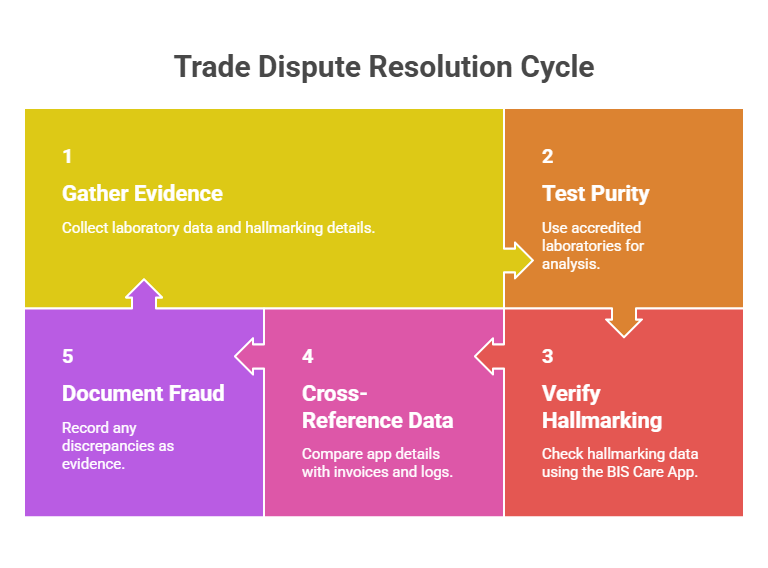
Before launching a formal trade dispute, you must compile an unassailable dossier of evidence. In cross-border trade, verbal assertions carry zero weight. You must translate physical product defects into universally accepted, legally recognized laboratory data. Official bodies will only review your case with this paperwork.
Accredited Laboratory Testing Protocols
Do not rely solely on your internal quality control team’s word if you discover a purity or material defect. You must obtain an independent, third-party element breakdown. Request a complete X-Ray Fluorescence (XRF) or Inductively Coupled Plasma (ICP) analysis. The laboratory should hold formal national or international accreditation. Indian authorities require this accreditation to recognize the data during official trade dispute arbitrations.
The Evolving Silver HUID Landscape
When vetting your items, use the official BIS Care App to review the hallmarking data. Importers should note that while mandatory Hallmark Unique Identification (HUID) has been the standard for gold for years, it is a relatively recent mandate for silver, having rolled out in September 2025.
When you input the 6-digit alphanumeric code into the app, it will display the purity grade, the registration number of the jeweler, and the specific details of the certified assaying center. The app will not automatically flag an export fraud mismatch; instead, you must manually cross-reference the assaying center details and the registration numbers provided on the app against the physical invoices and location logs your supplier claimed to use. If the app reveals that the items were certified under an entirely different company name or city, you have documented clear manual evidence of unauthorized subcontracting.
2. Regulatory Channels to Settle an Indian Jewellery Supplier Dispute
Pushing their operations into a formal regulatory review gives you immediate leverage over an uncooperative manufacturing unit. In India, an exporter cannot ship commercial goods legally without an active Import-Exporter Code (IEC) from the Ministry of Commerce. Threatening their operational pipeline hits their bottom line immediately.
The Quality Complaints and Trade Disputes (QCTD) Portal
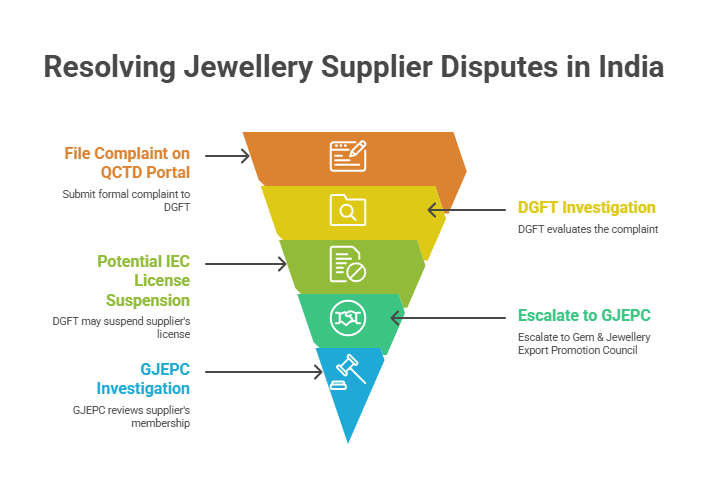
The Directorate General of Foreign Trade (DGFT) provides a specialized, online enforcement channel. This portal helps international buyers facing contractual breaches. To log a formal complaint, follow the precise official path directly on the Official DGFT Portal:
dgft.gov.in ➔ Services ➔ File Quality/Trade Grievances ➔ fill Online Application Form
Once submitted, a Unique Reference Number (URN) is generated and sent to your email to track the dispute. The case is evaluated by the jurisdictional Regional Authority of the DGFT or the relevant Indian Mission abroad. The DGFT treats quality fraud and unethical commercial dealings—such as non-supply after receiving funds—as systemic threats to the nation’s export reputation. While a foreign buyer cannot directly trigger or force an immediate license freeze, the filing initiates an official investigation. If the Regional Authority finds the supplier to be operating in bad faith, it holds the statutory power to initiate debarment or formally suspend the firm’s IEC license.
GJEPC Committee Escalation
Simultaneously, you should escalate the case to the Gem & Jewellery Export Promotion Council (GJEPC). Since nearly all reputable jewelry manufacturers rely on their GJEPC Registration-Cum-Membership Certificate (RCMC) to access critical duty drawbacks, export incentives, and international trade shows, council leverage is significant.
The GJEPC operates under a strict Code of Ethics which empowers it to investigate complaints received from foreign importers regarding quality discrepancies or the non-performance of export contracts. When a complaint is formally logged, the council reviews the member’s standing. If the manufacturer is found to be uncooperative or fraudulent, the GJEPC can suspend or revoke their membership, cutting off their access to international trade platforms, tax incentives, and subsidized raw material clearing facilities.
3. Structural Sourcing Frameworks: 2024 vs. 2026
The strategy for resolving an Indian jewellery supplier dispute depends heavily on whether your supply contract included clear alternative dispute resolution parameters or if you are operating on open, unhedged payment accounts. Over the past two years, the formalization of Indian trade infrastructure has shifted power back to the buyer.
| Dispute Resolution Metric | Legacy Sourcing Rules (2024) | Modern Trade Safeguards (2026) |
| Enforcement Body | Local Civil Courts (Slow) | DGFT QCTD Single-Window Digital Portal |
| Financial Lever | Unsecured open accounts | Bank-to-Bank Escrow / Trade Insurance Contracts |
| Regulatory Action | Minor local fines | Potential IEC License Suspension Post-Investigation |
| Institutional Recourse | Uncoordinated trade bodies | Direct GJEPC Code of Ethics Investigation Panels |
If a significant amount of capital is locked up and your contract contains an international mediation or arbitration clause, the case can be referred directly to a recognized arbitration hub, such as the Indian Council of Arbitration (ICA). This provides an accelerated conciliation pathway that avoids the years-long delays typical of traditional civil litigation.
4. The “Human API” and Last-Mile Dispute Settlement
While digital portals and formal complaints provide excellent structural leverage, the final settlement of a trade dispute is almost always achieved through direct, strategic negotiation on the ground. This process requires a physical presence that software simply cannot replicate.
This requirement is why leading international brands utilize a “Human API”—a local sourcing and compliance expert who steps onto the factory floor as your physical proxy. An algorithm can flag a contract breach, but it cannot sit down with a factory owner in Jaipur, Surat, or Mumbai to engineer a realistic recovery plan.
A local expert manages the crucial tactical layers of a dispute on your behalf:
- Escrow Settlement: Our specialists handle on-ground escrow verifications through our dedicated Jewelry Sourcing India management channels. They oversee the safe return of funds through verified bank-to-bank international transactions, ensuring all Indian customs and banking records are updated to reflect a legitimate trade return.
- Asset Auditing: Physically counting and locking down existing raw material or casting trees to ensure your precious metal assets are not liquidated or moved to an off-site workshop during the dispute.
- Remediation Management: If the supplier agrees to re-manufacture the batch, the local expert provides daily oversight to ensure the replacement pieces meet the original technical requirements.
The Strategic Shift: Building a Defensible Supply Chain

Experiencing a major supplier breach is an expensive lesson in cross-border risk management, but it does not mean your regional sourcing model is broken. Instead, it indicates that your verification framework was incomplete from the outset.
The ultimate takeaway from an Indian jewellery supplier dispute is that security requires a multi-layered approach. By combining digital tools like the DGFT QCTD portal with physical on-ground representation, your brand can build an operational framework that minimizes risk, protects capital, and holds manufacturing partners fully accountable to global standards.