
Your first high-volume order of sterling silver pendants has arrived from a new Jaipur partner. The spot-test reads 90.5% purity, just enough to fail legal sterling standards in Berlin or New York. The cost of a product recall, the legal exposure under consumer protection law, and the reputational fallout are immediate.
This scenario is more common than the industry admits, and it is entirely preventable. If you want to verify 925 silver suppliers in India the right way in 2026, a photograph of a hallmark stamp is not enough. This checklist walks you through seven checkpoints that separate reliable exporters from costly mistakes.
1. HUID Verification: The Digital Purity Standard for 925 Silver
The traditional ‘925’ stamp can be applied by any workshop using a basic steel punch. In 2026, India’s Hallmark Unique Identification (HUID) system has replaced it as the real baseline for silver purity verification.
Every hallmarked piece now carries a unique 6-digit alphanumeric HUID code tied to the manufacturer, the assaying centre, and the certified purity level. You can verify all three in real time using the BIS Care App before a shipment leaves the factory.
2. XRF Silver Testing: The Chemical Layer You Cannot Skip
HUID covers domestic legal compliance. For export, you need an X-Ray Fluorescence (XRF) report from an NABL-accredited third-party laboratory. Unlike the acid test, XRF is non-destructive and gives you an element-by-element breakdown of the alloy.
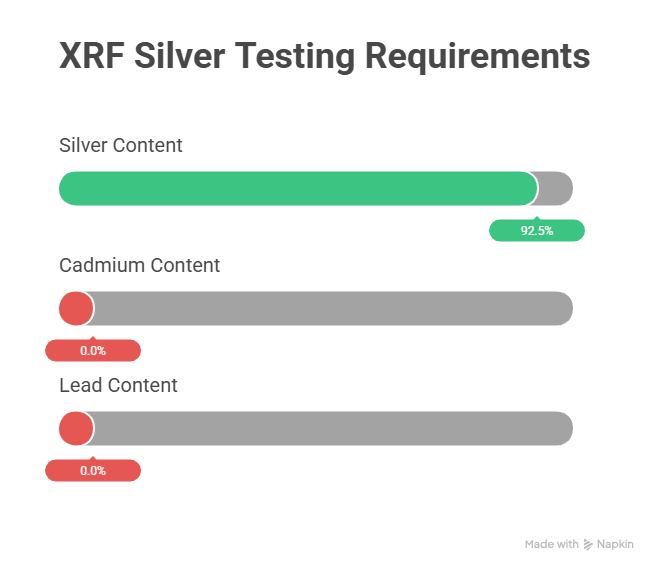
Three numbers to look for in every XRF report:
- Silver content at 92.5% or above
- Cadmium at 0.0% (a neurotoxin regulated under EU REACH)
- Lead at 0.0% (prohibited under US Prop 65)
3. RJC and Recycled Silver Certification: Sustainability Is Now a Compliance Requirement
The EU’s Cradle-to-Gate transparency laws require Western brands to document the origin of their precious metals. Verbal assurances from a supplier do not meet the standard. You need paper.
When auditing a sterling silver supplier in India, verify whether they hold active Responsible Jewellery Council (RJC) Chain-of-Custody certification or source using Global Standard for Recycled (GSR) grain. As of Q1 2026, fewer than 60 silver manufacturers in the GJEPC registry hold active RJC certification. If a supplier claims compliance, ask for their member ID and verify it.
4. Factory Verification: The On-Ground Check AI Cannot Replace
A significant number of Jaipur exporters coordinate orders but outsource production to unverified workshops with no quality systems or safety standards. Your on-ground audit needs to confirm that the unit you vetted is the one making your product.
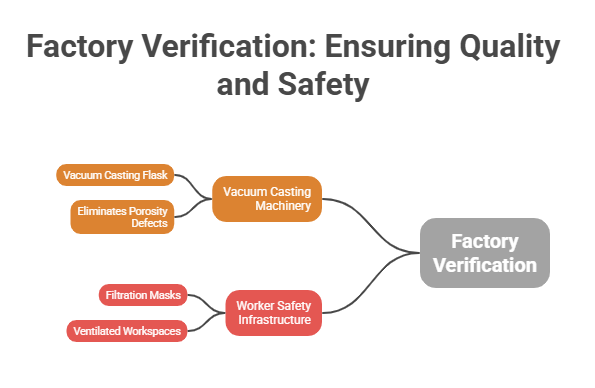
Two things to look for during any physical or virtual walkthrough:
- Vacuum casting machinery: the presence of a vacuum casting flask, rather than open-air sand casting, is the fastest visual indicator of export-grade manufacturing. It eliminates porosity defects that cause inconsistent metal weight across batches.
- Worker safety infrastructure: filtration masks for silver dust and ventilated workspaces. A factory that cuts corners on worker safety will cut corners on your product quality too.
This on-ground layer is what we refer to as the Human API: a local sourcing expert who bridges the gap between your data and the physical reality of the workshop floor.
5. GJEPC Registration: The Formal Exporter Test
A skilled workshop is not the same as a reliable exporter. Request the Registration-Cum-Membership Certificate (RCMC) from the Gem and Jewellery Export Promotion Council (GJEPC). This confirms the supplier is subject to government audit and compliant with Indian export regulations.
GJEPC membership is also a prerequisite for accessing duty reliefs under the India-US Interim Agreement, a direct financial benefit your procurement budget should be capturing.
6. CAD/CAM Integration and the Manufacturing Yield Ratio
Small design changes can create large downstream errors in silver manufacturing, a problem known as the Bullwhip Effect. The safeguard is digital manufacturing discipline. Any serious Indian silver manufacturer should operate fully within a CAD/CAM environment.
The key metric to request is the Manufacturing Yield Ratio (MYR):
MYR = (Weight of Finished Goods/Weight of Raw Casting Tree) x 100
For sterling silver pendants in the 5 to 8 gram range, a top-tier Jaipur manufacturer will report an MYR between 88% and 92%. If a supplier gives you a round figure like ‘90% always,’ they are estimating. Reliable MYR data has variance, and that variance is proof the manufacturer is measuring production rather than guessing at it.
7. Last-Mile Logistics and the EU-India Trade Framework
The EU-India Trade Pact reached a political conclusion in early 2026 and is expected to ease trade flows significantly once ratified. For most brands, however, the practical bottleneck remains documentation speed, not production speed.
When evaluating logistics readiness, check for three things:
- Insured or armored logistics for high-value silver shipments
- A documentation system that integrates with your customs broker
- Familiarity with duty-free entry requirements under current trade frameworks
A supplier who treats paperwork as secondary to production will cost you money at the border. In 2026, delays in documentation are just as expensive as delays on the factory floor.
Sourcing Standards at a Glance: 2024 vs. 2026
| Vetting Metric | Standard Practice (2024) | Mandatory Requirement (2026) |
| Purity Proof | “925” Stamp only | 6-Digit HUID + BIS Care App verification |
| Chemical Audit | Manual acid test | XRF breakdown: Lead and Cadmium at 0.0% |
| Sustainability | Verbal assurance from supplier | RJC or GSR Chain-of-Custody documents |
| Trade Status | Unverified workshop | GJEPC-registered exporter (RCMC cert) |
| Manufacturing Data | Estimated or verbal MYR figures | CAD/CAM-verified Manufacturing Yield Ratio |
The Indibuying Verdict: Verification Is the Competitive Advantage

The ‘925’ stamp was never a sufficient safeguard. It was simply the easiest thing to ask for. To genuinely verify 925 silver suppliers in India in 2026, brands need a layered approach: digital verification through HUID, chemical verification through XRF, structural verification through GJEPC and RJC credentials, and physical verification through on-ground audits.
The brands that win in global jewelry retail are not those with the most inventory. They are the ones who have built their supply chain into a competitive advantage rather than a liability. These seven checkpoints are where that advantage begins.