
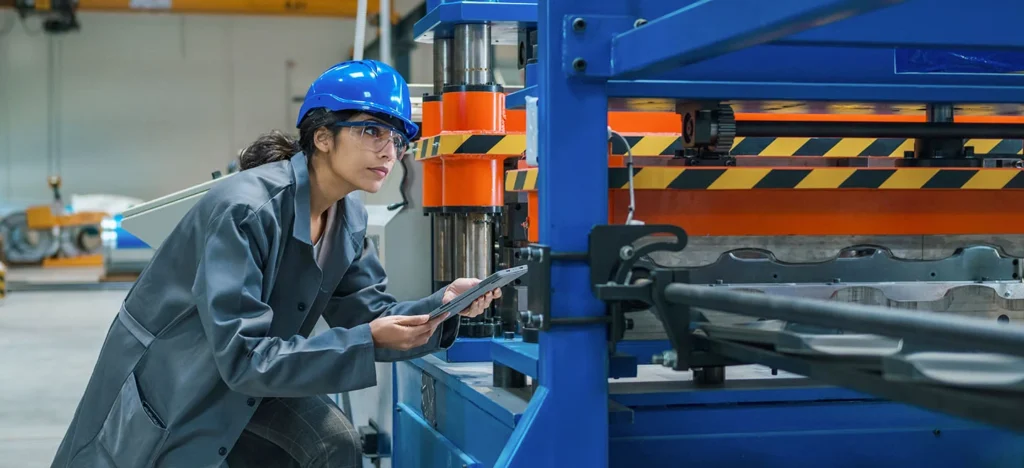
The cross-border buying pipeline for consumer brands often breaks down at the intersection of expectation and reality. For a growing business, flying out to manufacturing hubs like Surat or Mumbai is simply an economic impossibility. Consequently, the flights, hotels, and days spent away add a massive layer of overhead. These hidden travel costs eat directly into your retail margins.
Yet, relying entirely on a factory manager’s WhatsApp photos introduces a severe degree of systemic risk. When you are thousands of miles away, a simple misunderstanding can easily morph into a commercial disaster. Therefore, managing an overseas factory successfully requires a major mental shift. You must transition away from needing a physical presence on the factory floor. Instead, you should establish a smart system of remote digital checkpoints. If you want to master product inspection India from your home office, you do not need an engineering degree. Furthermore, you do not need an unlimited travel budget. You just need a practical, data-driven framework that replaces trust with verifiable data.
1. The Digital Blueprint: Locking in Expectations Before Production Begins
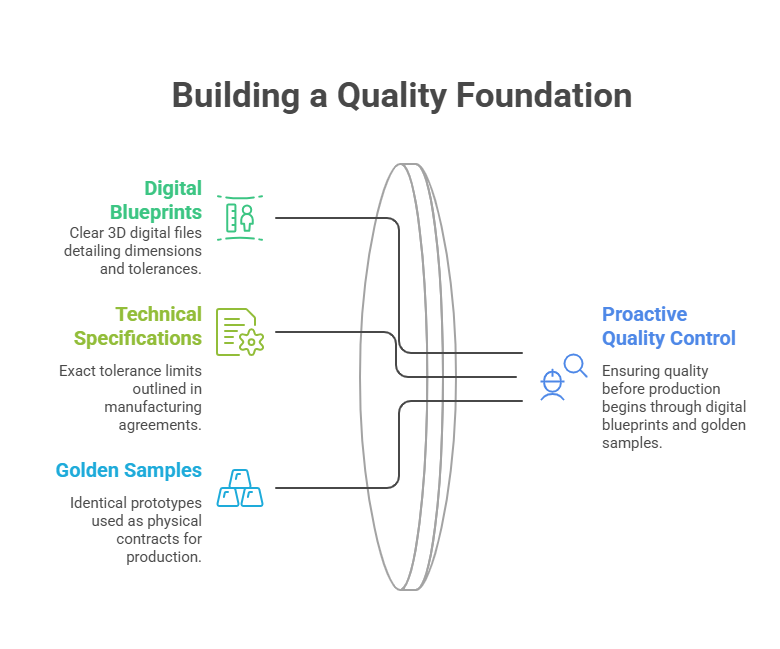
Quality control is a proactive engineering setup, not a reactive post-shipment check. Long before a single production machine turns on or raw metal is cast, you must establish an undisputed technical baseline. This baseline serves as your digital proxy on the factory floor, eliminating the linguistic and cultural nuances that often lead to manufacturing errors.
Moving Past the Loose Sketch
Many independent brand owners make the mistake of initiating a production run based on a loose drawing, a Pinterest mood board, or a reference photograph of an existing product. This is a recipe for variance.
Instead, always lock down your designs using clear 3D digital files (such as CAD models) that explicitly detail millimeter dimensions, wall thicknesses, and target weights. Your technical specification sheets must outline your exact tolerance limits. For example, explicitly write into your manufacturing agreement that a finished product’s weight must fall within a strict $\pm2\%$ boundary of your digital prototype. If a batch deviates from this, the data does the talking, not your emotions.
The “Golden Sample” Strategy
Before signing off on mass production, require the factory to courier two identical, finished prototypes to your office. Spend time holding them, testing their durability, and checking them under natural light. Once you are completely satisfied, keep one on your desk as your control reference.
Sign the second prototype with a permanent marker, seal it in a transparent bag with a tamper-evident label, and mail it right back to the factory manager. This signed counter-sample stays in the factory’s quality room. It serves as the physical contract. During production, the workshop floor managers must match your mass-produced goods directly against this sample.
2. Remote Systems for Product Inspection India
Using targeted video gatekeepers gives you immediate, real-time transparency over your overseas manufacturing pipeline. You do not need to absorb the heavy financial overhead of international travel just to look at your goods. By setting up mandatory milestone calls, you can catch errors while the products are still inside the factory gates.
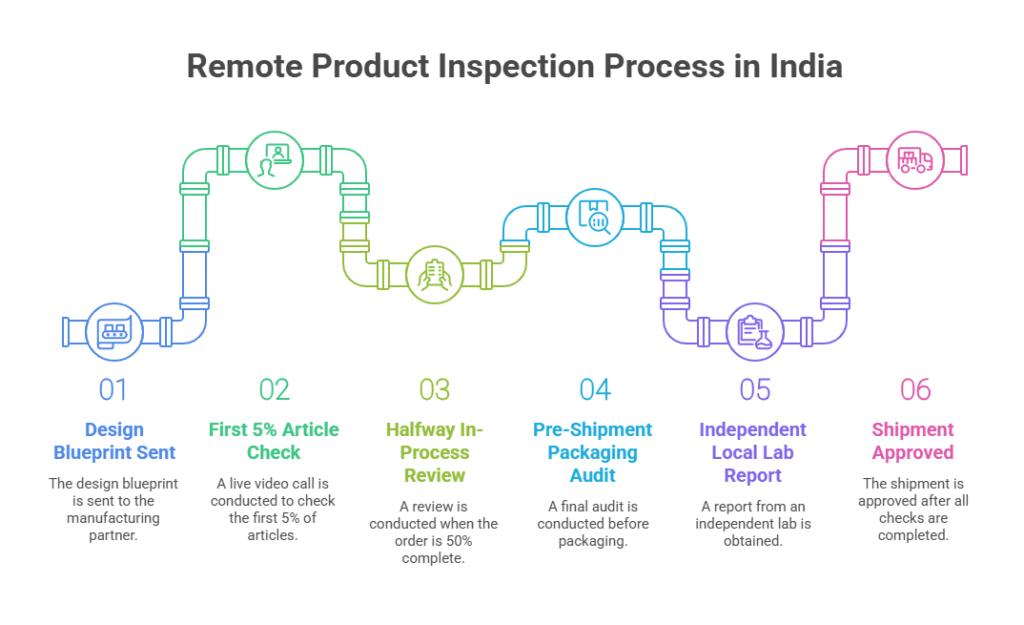
[Design Blueprint Sent] ➔ [Live Milestone Video Calls] ➔ [Independent Local Lab Report] ➔ [Shipment Approved]
The Three Mandatory Video Milestones
Contractually obligate your manufacturing partner to connect with you via a high-definition video call at three critical junctures of the production cycle:
- The First 5% Article Check: Schedule a live call the exact day the first small handful of items roll off the line. This is your insurance policy. If a machine is calibrated incorrectly or a mold has a structural flaw, you will spot it immediately on your screen before the factory processes the remaining 95% of your raw materials.
- The Halfway In-Process Review: Connect again when the order is roughly 50% completed. Have the factory manager pull a few pieces completely at random from the active polishing or assembly benches. This milestone lets you evaluate surface finishes, color consistency, and moving parts before they get moved to the final packing department.
- The Pre-Shipment Packaging Audit: Before the master cartons are taped up and loaded onto a pallet, run a final visual check. Verify that your barcodes are scannable over the video feed, retail labels are applied straight, and the inner padding is robust enough to protect your margins.
To make these calls highly effective, ask the factory to invest in a cheap smartphone macro lens or a digital microscope attachment. Watching a manager place your product under a macro lens live on a call gives you an incredibly clear view of solder joints, stone settings, or surface textures right from your computer screen.
3. Simple Testing Protocols Over Verbal Promises
When a dispute arises, an unverified factory manager will almost always claim that the batch passed their internal checks. To protect your capital, your remote quality control India framework must rely on independent, empirical testing rather than verbal assurances.
The Independent Laboratory Document
If your products involve precious metal plating or specific alloys, never accept a verbal guarantee of purity. Require the factory to send a few random pieces from your finished lot to an independent, certified testing laboratory in their local hub.
The lab will run a non-destructive test and email an element report directly to you. For brands selling into Western markets, this document is your legal shield. It proves your batch has a 0.0% presence of hazardous neurotoxins like Lead or Cadmium, ensuring you are fully compliant with strict consumer protection laws like EU REACH or US Proposition 65.
Auditing the Workshop Efficiency Score
Ask your supplier to share their internal manufacturing yield data for your specific batch. If a factory starts a production run with 10 kilograms of raw silver grain, a highly disciplined, export-grade workshop should yield a predictable, stable output of finished, defect-free items.
If their internal numbers show wild fluctuations or sharp drops in efficiency during your production run, it is a massive warning sign. This data pattern typically indicates that the workshop processes are unstable, or worse, that the factory is quietly outsourcing your order to smaller, unverified backyard workshops to meet a deadline.
4. Sourcing Frameworks: Traditional On-Site vs. Modern Remote Oversight
| Sourcing Milestone | The Legacy On-Site Way | The Modern Remote-First Protocol |
| Material & Purity Proof | Trusting the stamped mark on the metal | Independent laboratory reports sent directly to your email |
| Production Oversight | Paying for costly, exhausting factory visits | Three scheduled video calls at critical production milestones |
| Catching Defects | Discovering errors after unpacking at your warehouse | Identifying and correcting errors live on video before export |
| Risk Management | Arguing over replacements after final payment | Withholding final balance transfers until data checks pass |
Digital twin files, high-definition video streams, and digital laboratory reports create a powerful foundation for remote management. However, when an order represents a massive chunk of your business’s operating capital, some high-stakes parameters demand a physical touch. You can bridge the geographical gap by deploying a “Human API.”
A Human API is an independent, professional local inspector or boutique sourcing agent located directly within the manufacturing hub. They act as your physical proxy, stepping onto the factory floor to conduct a rigorous pre-shipment audit right before the goods leave the building.
Your on-ground proxy executes three vital checkpoints that pixels cannot replicate:
- True Random Sampling: They will walk into the warehouse and pull sample boxes from the bottom or back of the pallet themselves. This prevents the factory manager from hand-picking a few “perfect” pre-prepared items to show during a routine check. Importers can verify these procedural steps directly through the official DGFT Portal guidelines for trade validation.
- The Standardized Carton Drop Test: They will physically drop your packed master shipping cartons from specific heights onto a hard floor. This ensures the internal cardboard inserts and padding can actually survive rough airport transit and customs handling without collapsing.
- The Manual Mechanical Stress Test: They will manually flex, pull, and open clasps, buttons, or joints on hundreds of randomly sampled pieces to guarantee that the hardware will not snap under normal consumer wear.
Conclusion: Building a Defensible Supply Chain

Operating a highly profitable supply chain from a home office is entirely possible. It is no longer a futuristic concept. Instead, it is standard operating procedure for the modern brand. The absolute key is replacing emotional guesswork with systematic checkpoints.
You must lock in your digital blueprints. Use video gatekeepers and require independent laboratory proof. You can partner with local proxy inspectors when the stakes are high. By doing this, you build an ironclad quality loop. Our team handles these remote checks and on-ground audits through our dedicated management pipeline.