

Mastering your landed cost is the single most important factor for profitability when sourcing from India in 2026. If you were a boutique brand in Austin or a mid-sized furniture distributor in Chicago, you could pull $750 worth of samples from a factory in India, ship them via air express, and they would land on your doorstep with zero paperwork and zero duties.
That era ended abruptly.
As of March 2026, the framework has evolved. The $800 duty-free threshold has been updated for commercial imports to ensure a more regulated and transparent trade environment. Today, that same $750 box of samples follows a more formalized path: a formal customs entry, a mandatory broker fee, a 10% global surcharge (Section 122) applied on top of standard duty rates.
(Note: The 18% reciprocal deal is currently stalled following the Feb 20, 2026 Supreme Court ruling)
Ultimately, this change means that the final landed cost of your goods now reflects a more detailed set of international rules. If you are focused on sourcing from India, your financial planning can no longer stop at the factory door; it must now account for the professionalized steps required to clear customs at the border.
Part I: The Shift from “De Minimis” to “Formal Entry”
For years, the “De Minimis” (Section 321) rule was a convenient tool for the rapid, small-scale testing of new Indian product lines. It allowed shipments under $800 to enter the US with minimal friction.
Under the 2026 regulatory framework, the process has matured. Commercial shipments now move through a formal entry process, bringing a new level of professionalism and data accuracy to the US-India trade corridor.
The New Math of Small Shipments
The most significant change for growing enterprises is the “fixed cost” of entry. In 2025, a small sample order was essentially “price + freight.” In 2026, every shipment, regardless of size—triggers a series of mandatory processing fees.
Shipment Size Comparison (India to US – 2026):
| Shipment Value | The “Old” Way (Pre-2025) | The “New” Way (March 2026) | Effective Increase |
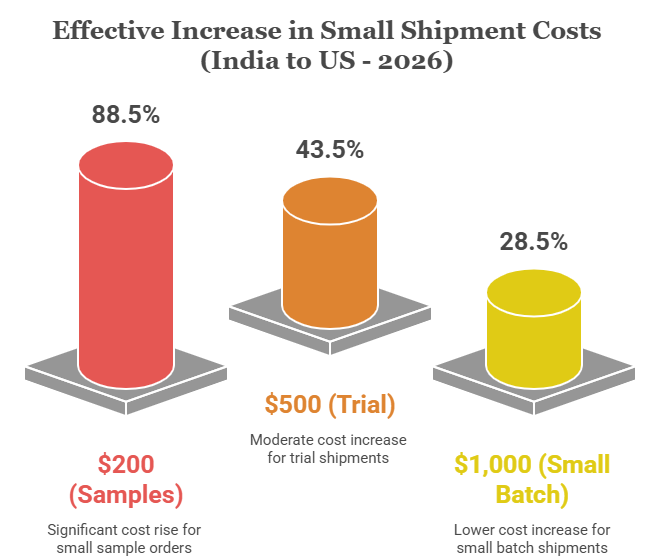
| $200 (Samples) | $0 Duty / $0 Entry Fee | $27 Duty* + $150 Brokerage | +88.5% |
| $500 (Trial) | $0 Duty / $0 Entry Fee | $67.50 Duty* + $150 Brokerage | +43.5% |
| $1,000 (Small Batch) | $0 Duty / $0 Entry Fee | $135 Duty* + $150 Brokerage | +28.5% |
The Consolidation Solution for a Lower Landed Cost
The move to “Formal Entry” has changed the math of shipping. In the past, you could ship many small packages at a flat rate. Today, every shipment requires a customs broker and formal paperwork, which costs between $150 and $300 per filing, regardless of whether the box is worth $500 or $50,000.
Because this entry fee is a fixed cost, your profit per unit is now directly tied to your shipping volume. If you ship small batches frequently, you are paying that $200 fee over and over. The goal in 2026 is batch optimization: moving from high-frequency, small-parcel shipments to a consolidated monthly model.
Part II: Navigating the 2026 Duty Stack to Control Your Landed Cost
As noted in our recent trade update, the current US-India trade environment is characterized by a temporary 10% global surcharge under Section 122. While this replaces the high-volatility punitive rates of the past, it requires a more disciplined approach to cost-modeling.
Beyond the 10%: The Total Stack
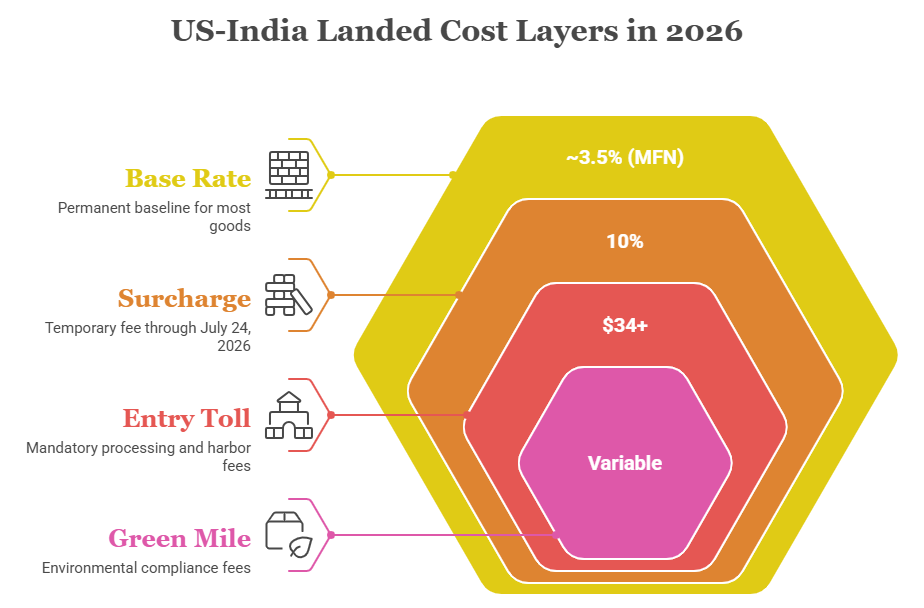
In 2026, a professional Landed Cost isn’t a single number; it is a stack of specific layers. Think of it like a building, if one layer is unstable, your entire profit margin can collapse. To forecast with precision, you must account for these four primary layers:
- The Base Rate (~3.5%): Following the Supreme Court’s invalidation of reciprocal trade authorities on Feb 20, 2026, the 18% deal is stalled. Most Indian goods have effectively returned to standard “Most Favored Nation” (MFN) rates for now.
- The Surcharge (10%): This is a temporary global surcharge under Section 122, effective Feb 24, 2026. It is scheduled to expire on July 24, 2026, unless extended.
- The Entry Toll (~$34+): Every formal shipment into the US now pays mandatory “processing” and “harbor” fees (MPF/HMF). Even if your shipment is small, these minimum fees apply.
- The Green Mile: New US mandates for electric trucking at major ports have introduced “Green Surcharges.” Moving your container from the pier to your warehouse now costs more than it did a year ago due to these environmental compliance fees.
Part III: The 2026 Landed Cost Strategy Checklist
To ensure your margins don’t evaporate between the factory in Moradabad and your warehouse, audit every shipment against this March 2026 reality check.
| Cost Component | 2026 Regulatory Status | Impact on Your Bottom Line | Before 2025 | After 2026 |
| Factory Price (EXW/FOB) | The base cost from your Indian supplier. | Now represents only ~55% of the total cost. | $1,000 | $1,000 |
| Duty & Tariffs | 3.5% MFN + 10% Surcharge | Replaces 0% GSP; must be hard-coded into pricing. | $0 (under GSP) | $135 (28% total) |
| Entry & Brokerage | Mandatory for formal entries; typically $150–$300. | Fixed costs that penalize small, frequent shipments. | $0 (De Minimis) | $200 (Avg. fee) |
| Processing Fees | MPF/HMF minimums (~$34). | Mandatory “tolls” for every formal entry. | $0 | $34 |
| Total Landed Cost | The final price at your door. | Margins are won or lost here. | $1,000 (+Freight) | $1,369 (+Freight) |
Part IV: The HTS Opportunity—Unlocking “Hidden Zeroes”
One of the most effective ways to optimize Landed Cost in 2026 is through HTS (Harmonized Tariff Schedule) Optimization. While broad categories face the 13.5% stack, specific sectors, namely generic pharmaceuticals, specific jewelry components, and unworked diamonds—currently qualify for 0% duty under separate executive carve-outs.
The challenge often lies in “Classification Drift.” This occurs when a product is assigned a generic code (e.g., “Wooden Decorative Item”) that defaults to the standard 18% rate, when a more specific code (e.g., “Certified Hand-Carved Handicraft”) would have landed at 0%. This is not about avoiding duties; it is about high-level technical compliance to access the preferential rates established by the US-India framework.
The Indibuying Verdict: The Art of Margin Engineering

The “India Advantage” hasn’t disappeared in sourcing 2026; it has simply changed its locks. The winners in this new landscape are no longer the importers who find the cheapest factory price, but the ones who master the “Border Math.”
At Indibuying, we view these formalized entries and “Duty Stacks” not as barriers, but as an evolution. The shift from the “grey market” shortcuts of the past to a transparent, data-backed supply chain is what makes a business resilient. By ensuring flawless paperwork and optimized HTS codes, you actively secure your margins against volatility
The Bottom Line: Whether you are consolidating small batches to outrun fixed brokerage fees or auditing your “Green Mile” surcharges, success in 2026 is won in the fine print. India has provided world-class manufacturing; it is now up to the modern importer to provide the world-class strategy.
In this era, your most competitive asset isn’t just what you buy, it’s how accurately you calculate its journey to your door.