
Update: March 3, 2026 — This article has been revised to reflect the February 20 Supreme Court ruling on IEEPA and the implementation of Section 122 global surcharges.
As we navigate the complexities of sourcing from India 2026, the boardroom of every mid-sized American and European importer has felt more like a war room. The ‘China+1’ strategy, once a corporate mantra, had suddenly become an expensive gamble as geopolitical tensions spiked.
But as of March 2026, the board has flipped.
The new bilateral trade deal between Washington and New Delhi has fundamentally re-engineered the trade relationship. However, a new reality is emerging: the Atlantic and the Pacific are no longer playing by the same rules. While the US is leaning into a “Reciprocity” model, Europe has just signed the most ambitious “Zero-Duty” deal in history. For the growing enterprise, navigating this divide is no longer about shipping; it’s about Policy Arbitrage.
Part I: The US “18% Ceiling”
The End of the IEEPA Regime
The “18% Ceiling” originally intended by the February 6 US-India trade framework is currently in a state of legal flux. On February 20, 2026, the US Supreme Court ruled in Learning Resources Inc. v. Trump that the International Emergency Economic Powers Act (IEEPA) does not authorize the President to impose sweeping reciprocal tariffs. This decision effectively dismantled the legal foundation of the country-specific “Agreements on Reciprocal Trade” (ARTs) that were set to define sourcing from India 2026.
The New 10-15% Global Surcharge
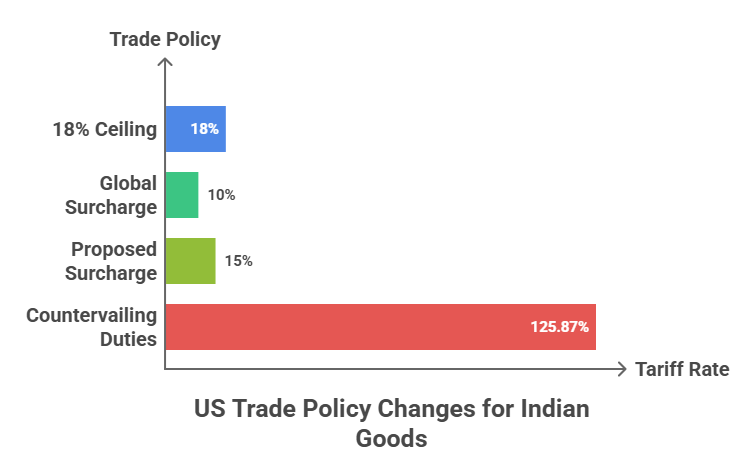
Undeterred by the ruling, the White House immediately pivoted to Section 122 of the Trade Act of 1974. Effective February 24, 2026, a temporary “global import surcharge” of 10% was imposed on nearly all US imports to address balance-of-payments deficits. While the administration has announced an intention to raise this to 15%, the current applied rate for Indian goods remains 10% broadly.
For Indian exporters, this creates a unique window:
- A Relative Victory: While the preferential 18% cap is currently stalled in negotiations, the flat 10% surcharge replaces previous punitive rates that reached as high as 50%.
- The 150-Day Clock: These surcharges are explicitly temporary and will expire on July 24, 2026, unless extended by Congress.
- Ongoing Volatility: Even as broad surcharges fall, targeted actions persist. On February 24, the US Department of Commerce imposed preliminary countervailing duties of 125.87% on solar cell imports from India, citing actionable government subsidies.
Part II: The European “Zero-Duty” Revolution
The India-EU FTA: A Once-in-a-Generation Pivot
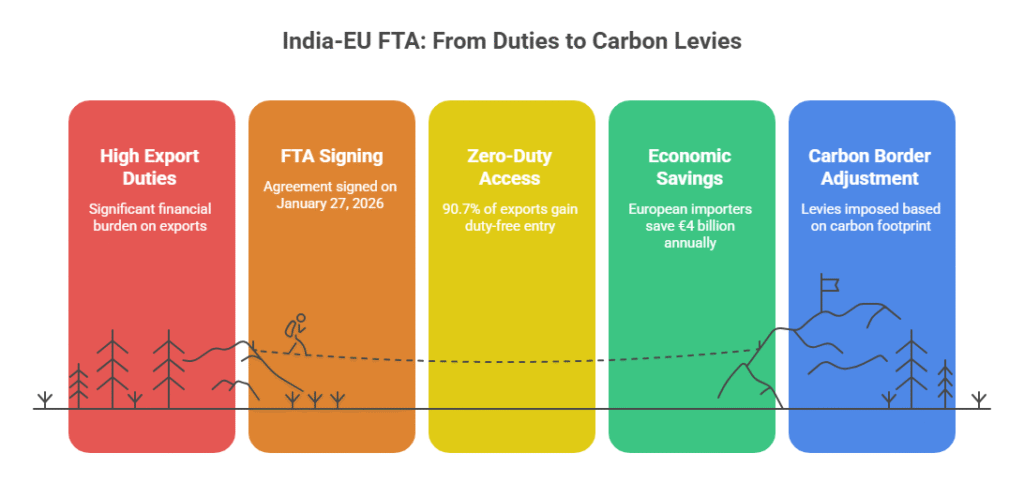
On January 27, 2026, the India-EU Free Trade Agreement (FTA) was officially signed. Unlike the US “reduction” agreement, the EU deal is a “removal” agreement.
- Immediate Zero-Duty: The EU has granted immediate zero-duty access for 90.7% of India’s export value. This is a massive windfall for labor-intensive sectors like textiles (previously 12%), jewelry, and footwear (previously 17%).
- Sector Winners: Indian tariffs on EU automobiles are dropping from 110% to 10%, while wines and spirits see phased cuts from 150% down to 20% over the coming years.
- Strategic Hedging: For Brussels, this deal serves as a hedge against volatile US trade actions. European retailers are moving primary manufacturing hubs to India to escape the uncertainty of the Transatlantic trade war.
The Trade-Off: The “Green Wall”
However, Europe’s “Zero-Duty” comes with strings: CBAM (Carbon Border Adjustment Mechanism) and EUDR (Deforestation Regulation). As of January 2026, the EU began collecting carbon levies. If your Indian supplier uses coal-heavy power, that “0% duty” could turn into a “20% Carbon Surcharge” at the port. Furthermore, the EUDR now requires polygon-level geolocation data for all wood and leather products.
Part III: Tying the Knot—A Sourcing from India 2026 Comparison
To win in the current market, growing companies must manage two completely different regimes. This comparison clarifies how the landscape of sourcing from India 2026 stacks up for your procurement team:
| Feature | The US Corridor (Post-Feb 24, 2026) | The EU Corridor (Post-Jan 27, 2026) |
| Effective Tariff Rate | 10% Global Surcharge (Section 122) | 0% Duty on 90%+ of Indian goods. |
| Legal Status | Temporary: Expires July 24, 2026 | Permanent: Phased implementation |
| Primary Goal | “Harm Reduction”: Reducing the sting of reciprocal trade policies. | “Market Integration”: Deep structural removal of trade barriers. |
| Key Exemptions | Pharma, Semiconductors, and Critical Minerals remain duty-exempt. | Immediate duty-free for Textiles, Leather, Toys, and Sports goods. |
| Compliance Barrier | “Buy American” Alignment: Pressure to shift energy and tech sourcing to the US. | “Green Standards”: Mandatory CBAM carbon reporting and EUDR traceability. |
| SME Advantage | Simplified digital trade instruments and reduced documentation. | Preferential access for services (IT/Consulting) and artisanal goods. |
| Strategic Move | Margin Engineering: Front-load shipments to lock in the 10% rate before the July 24 expiration | Supplier Auditing: Verifying “Carbon Intensity Scores” to avoid border levies. |
The Indibuying Verdict: The Art of Policy Arbitrage

Sourcing in 2026 is no longer about finding the cheapest factory; it is an exercise in Regulatory Strategy. For the first time in a decade, the “India Advantage” isn’t just about labor costs, it’s about the legal framework you choose to operate within.
At Indibuying, we are seeing a clear divergence in how our most successful partners are behaving.
- For US Importers: The game is “Clock Management.” With the Section 122 surcharges set to expire in July, smart brands are front-loading shipments to lock in the current 10% baseline before potentially more enduring Section 301 tariffs are enacted following the 150-day review period.
- For EU Importers, the challenge is “Data Traceability.” The 0% duty is a gift, but it is a gift with an audit trail. If you cannot prove your leather is deforestation-free or your textiles weren’t produced using captive coal power, the port authorities in Rotterdam or Hamburg won’t care about your FTA certificate. They will seize the goods.
The Bottom Line: Whether you are navigating the temporary 10% surcharge in New York or the “Green Wall” in Berlin, the success of your supply chain depends on your ability to navigate the fine print of 2026 trade. India has opened the door, but it is up to you to bring the right paperwork.
In this new era, the most valuable person in your company isn’t the buyer, it’s the trade compliance officer who knows that 10% is the new zero.