
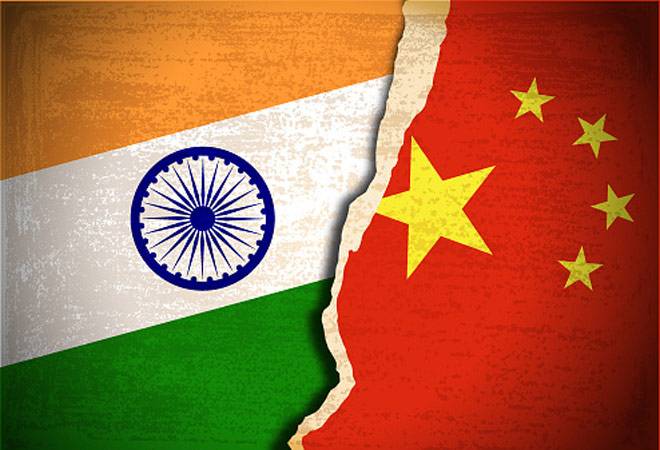
Update: March 16, 2026 — This article has been revised to reflect the February 20 Supreme Court ruling on IEEPA and the implementation of Section 122 global surcharges.
Navigating the shifting landscape of India vs China sourcing has become the primary challenge for supply chain leaders in 2026. Imagine you are a supply chain leader in Chicago. For over a decade, your global strategy was anchored in the predictability of China efficiency. You knew the lead times from Ningbo to the hour, and your unit costs were locked behind years of volume scale.
Then, the framework shifted. By early 2026, those predictable margins vanished as new trade barriers and legal reversals turned your spreadsheets into a battlefield of red ink. You realize that the 25% punitive duties on Chinese imports are no longer just a temporary fee, they are a structural threat to your fiscal health.
Now, the focus has pivoted toward the subcontinent. While the promises of new trade deals and massive infrastructure hubs are compelling, the decision involves more than just factory gates. As we explored in our initial analysis of the 2026 Atlantic-Pacific Pivot, the winner is decided by “Border Math”—the complex intersection of duties and fees that define your success the moment your goods reach a US port.
Part I: New Rules for India vs China Sourcing in 2026.
For decades, China dominated the sourcing landscape through a hyper-integrated ecosystem. However, in 2026, that convenience comes with a significant premium.
The fundamental shift in India vs China Sourcing is the divergence in how the US government categorizes each partner. While China remains under the weight of restrictive trade actions, India has transitioned into a “strategic partnership” era.
The China Penalty vs. The India Pivot
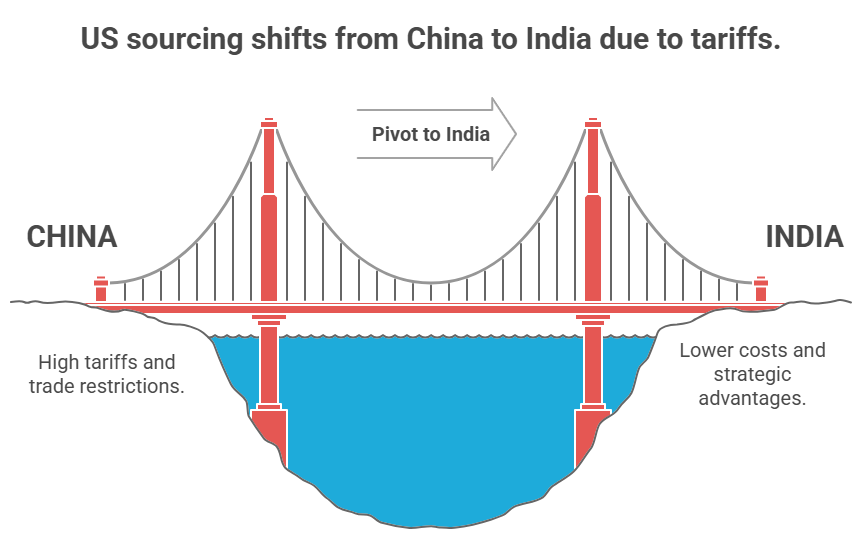
As of March 2026, the duty gap between these two manufacturing giants is wider than ever:
- The India Pivot: In February 2026, the US Supreme Court invalidated several heavy IEEPA-based tariffs on Indian goods. Even with the current 10% (section 122) surcharge, the effective tax on Indian goods is substantially lower than their Chinese counterparts.
- The China Penalty: Most Chinese imports still face a 25% baseline duty under Section 301. For high-growth sectors like electronics or textiles, these rates can escalate even further.
Part II: Engineering Your Final Landed Cost
A common strategic error is prioritizing the “ex-factory” price. In 2026, that figure is only one variable in a much larger equation. The question of India vs China sourcing is now a competition of “Landed Cost”—the total financial commitment required to move a product from the factory floor to your warehouse.
Let’s analyze a $5,000 shipment of industrial hand tools arriving in March 2026.
The 2026 Comparison: Landed Cost for $5,000 in Goods
| Cost Component | Sourced from China (2026) | Sourced from India (2026) | Strategic Impact |
| Factory Invoice | $5,000 | $5,250 | China holds a 5% factory-gate lead. |
| Base Duty (MFN) | $250 (5% avg.) | $250 (5% avg.) | The standard global baseline. |
| Additional Tariffs | $1,250 (Section 301 – 25%) | $500 (Section 122 – 10%) | India’s status saves $750 in duties. |
| Brokerage & Entry | $200 | $200 | Fixed costs for formal compliance. |
| Total Landed Cost | $6,700 | $6,200 | India is $500 cheaper overall. |
| Effective Tax Rate | 34% | 18% | A 16% gap in net margin. |

Part III: Infrastructure and the Logistics Convergence
India’s historical weakness was its fragmented infrastructure. Moving goods internally was often more costly than the ocean voyage itself. In 2026, the “Gati Shakti” master plan has fundamentally matured.
- Logistics Efficiency: India’s logistics spend is projected to fall below 9% of GDP by late 2026, nearing the 8% benchmark set by China.
- Transit Times: New shipping corridors from India’s west coast to the US East Coast have reduced sea transit by four days.
- Port Automation: Hubs like Mundra now employ advanced automation, ensuring that your goods spend less time in terminal dwell and more time in transit.
Part IV: Navigating the “Classification Trap”
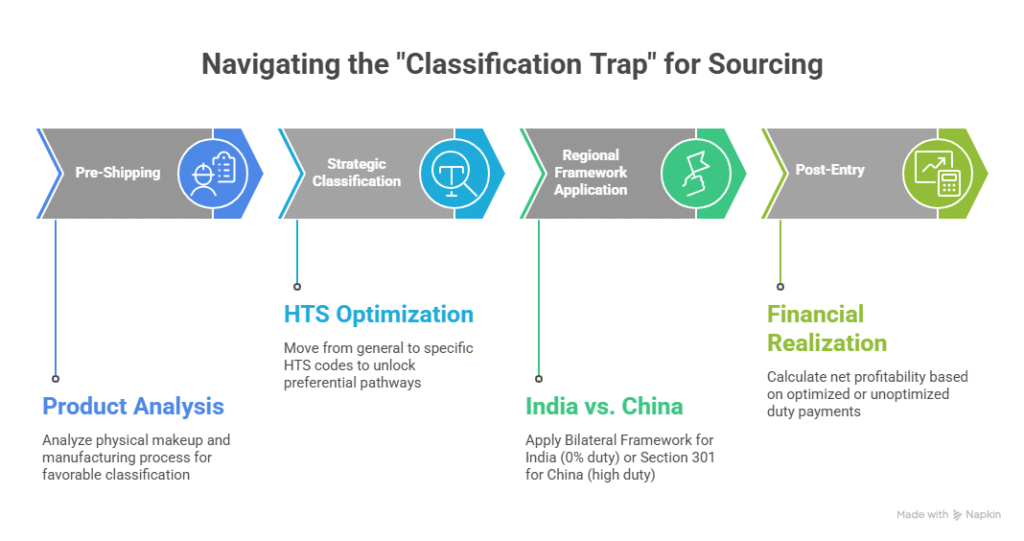
In the India vs China sourcing debate, your technical compliance determines your profitability. This is known as HTS (Harmonized Tariff Schedule) Optimization.
In 2026, precision in product description is a financial lever. For instance, generic Indian home decor might trigger the full duty stack. However, if those same items are certified as “Artisanal Hand-Carved Handicrafts,” they may qualify for 0% reciprocal duties under the new bilateral framework. China has almost no such preferential pathways remaining due to broad Section 301 coverage.
Part V: Building a Resilient Sourcing Framework
The “India Advantage” in 2026 is rooted in fiscal and political security. In a world defined by trade volatility, India has become a “safe harbor” for diversified supply chains.
Your 2026 Strategic Checklist:
- Audit HTS Classifications: Do not settle for generic codes; identify the specific categories that unlock reciprocal tax benefits.
- Consolidation Strategy: Since every shipment now requires a formal entry fee, avoid small-parcel air freight. Consolidate your inventory into larger batches to dilute fixed brokerage costs.
- Fiscal Planning: Monitor the sunset date of the 10% Section 122 surcharge (July 24, 2026) to optimize your Q3 inventory timing.
- Data Verification: For real-time duty tracking, procurement teams should consult the official U.S. Customs CROSS database.
The Indibuying Verdict: Reclaiming Your Competitive Edge
At Indibuying, we view the shift toward India not merely as a change in vendors, but as an evolution toward a transparent, data-backed supply chain.
By mastering HTS codes and the “Border Math,” you can reduce your total landed costs by 15-20% compared to a Chinese alternative. While China offers the legacy of manufacturing speed, India offers the future of supply chain resilience.
The Bottom Line: Success in 2026 is determined by the “Fine Print.” Profit does not go to the firm with the cheapest factory—it goes to the firm with the superior strategy.