
It is a Tuesday evening in a small office above a retail unit. A homeware brand founder has three browser tabs open, each showing a landed cost spreadsheet for a different country. Vietnam looks steady. Bangladesh looks cheap but risky. India looks promising, except for one stubborn line item: duty. Then the India UK Free Trade Agreement changes that calculation entirely.
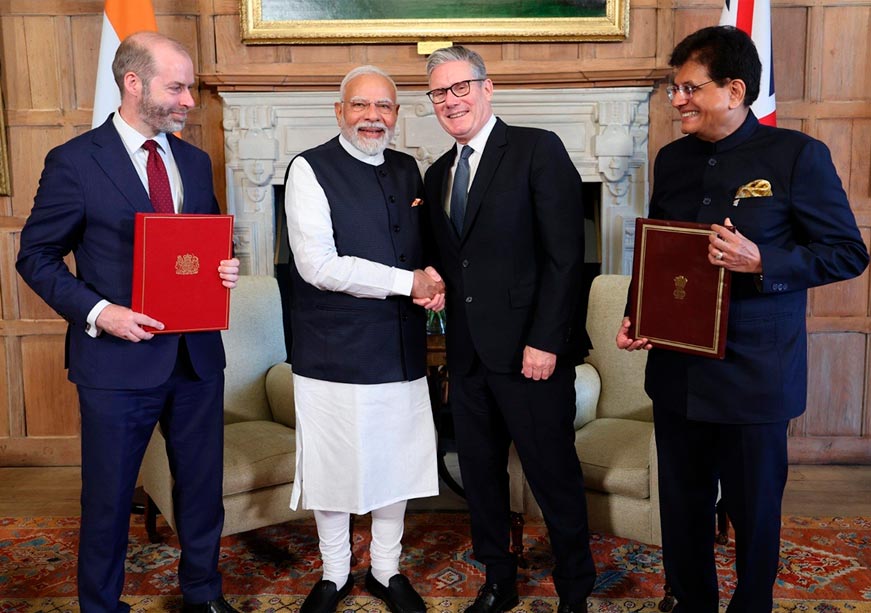
Then a notification appears. The headline reads that India and the United Kingdom have locked in a date. The India UK Free Trade Agreement, formally called the Comprehensive Economic and Trade Agreement, will come into force on July 15, 2026. That one line item is about to change for thousands of buyers exactly like her.
This is not a small policy update buried in a trade ministry newsletter. It is a structural shift in what it costs to bring Indian-made goods into the UK market, and it changes the competitive math for buyers everywhere, not just in Britain.
What the India UK Free Trade Agreement Actually Changes
The deal was signed in July 2025 after more than a year of negotiation. Both governments have now completed ratification, which clears the way for implementation on July 15, 2026.
Under the agreement, the UK will offer duty-free access on close to 99 percent of Indian exports by value. India’s Ministry of Commerce and Industry has confirmed that roughly 90 percent of India’s exports to the UK will become duty-free under the deal. The numbers vary slightly depending on the source, but the direction is the same: most tariffs disappear.
Several sectors see immediate, sharp cuts. Textiles and garments drop from a 12 percent UK tariff to zero. Leather and footwear fall from 16 percent to zero. Marine products move from 21.5 percent to zero. Engineering goods and auto components shift from 18 percent to zero. Even chemicals and pharmaceutical products, taxed at 8 percent, become duty-free.
| Product Category | Previous UK Tariff | Tariff Under the Agreement |
| Textiles and garments | 12% | 0% |
| Leather and footwear | 16% | 0% |
| Marine products | 21.5% | 0% |
| Engineering goods and auto components | 18% | 0% |
| Chemicals and pharmaceuticals | 8% | 0% |
| Furniture, gems and jewellery, sports goods | Up to 4% | 0% |
On the UK side, India will cut its average tariff on British goods from roughly 15 percent to 3 percent. Scotch whisky duties fall from 150 percent to 75 percent immediately, then taper to 40 percent over the next decade. The deal works in both directions, which is part of why it took so long to finalize.
The Deal That Nearly Stalled
The agreement was originally expected to take effect earlier in 2026. It did not, because of a dispute that had nothing to do with India.
In March 2026, the UK announced it would sharply reduce how much steel it imports duty-free, and would double the tariff on imports above that new quota. This was aimed at protecting British steelmakers from a global oversupply, but it complicated the broader trade agreement’s timeline. India and the UK spent weeks working through what officials called a creative solution before agreeing to move forward.
It is a useful reminder that even a finalized trade deal carries friction points until the day it actually goes live. Buyers who track only the headline date, without watching for last-minute snags like this one, can be caught off guard by shifting timelines.
Where India Now Stands Against Other Sourcing Hubs
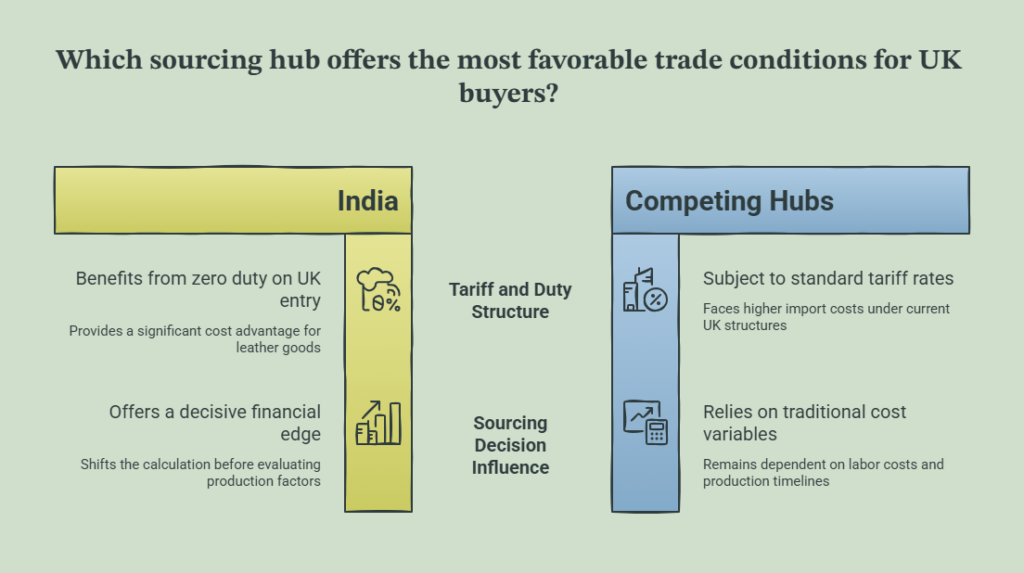
For years, buyers comparing India to Vietnam, Bangladesh, or China have weighed labor cost, lead time, and quality control against each other. Duty rates rarely tipped the scale, because most competing countries faced similar UK tariff structures.
That balance shifts on July 15. A buyer sourcing leather goods from India will pay zero duty on UK entry, while the same product from a country without a comparable agreement still carries its standard tariff. Multiplied across a full order, that difference can move a sourcing decision more decisively than a small difference in unit cost ever could.
This does not make India automatically the cheapest option in every category. Labor costs, minimum order quantities, and production timelines still vary widely by country and by product. What changes is the calculation buyers run before they even get to those factors. Duty-free access removes one major variable that used to favor other regions by default.
Categories Positioned to Benefit First
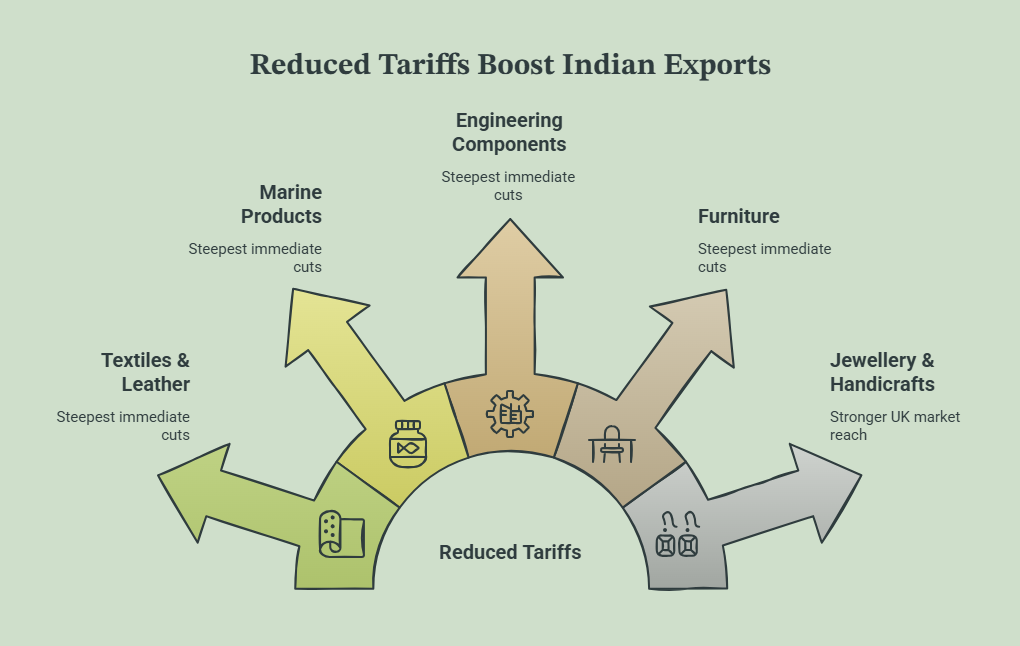
Textiles, leather, marine products, engineering components, and furniture see the steepest immediate cuts, which makes them the categories worth prioritizing first if a buyer is reassessing sourcing strategy this year.
Jewellery, handicrafts, and furniture also stand to gain, particularly given the UK’s existing demand for these categories and India’s established manufacturing bases in cities like Jaipur and Jodhpur. Jaipur’s gems and jewellery workshops and Jodhpur’s furniture and crafts industry are both named as direct beneficiaries, with reduced tariffs expected to translate into stronger UK market reach for both regions. Buyers in these categories who were previously absorbing UK duty as a fixed cost now have room to either improve margins or pass savings into more competitive UK pricing.
India UK Free Trade Agreement Compliance: What Buyers Need to Do Now
Tariff elimination is not automatic at the point of import. To claim the reduced rate, UK businesses need to complete a one-time origin registration with HMRC through the Origin Registration portal, and products must meet specific Rules of Origin requirements tied to the agreement.
This is the part of the deal that gets less attention than the tariff numbers, but it determines whether a buyer actually captures the savings on day one or spends months untangling paperwork after the fact.
Why a Local Partner Matters More Now, Not Less
A lower duty rate only helps if everything behind it works. Production quality, on-time delivery, and accurate documentation still determine whether an order actually clears customs and reaches a buyer’s shelves on schedule.
This is where having a sourcing agent in India earns its place in the process. A sourcing agent in India can verify that a supplier’s paperwork aligns with the new Rules of Origin requirements, confirm product categories qualify for the reduced tariff, and catch quality issues before goods ever leave the workshop. The agreement removes a cost barrier. It does not remove the need for someone on the ground who knows which workshops actually deliver what they promise.
The Window Is Open

July 15, 2026 is not just a policy date. It is the point where India’s manufacturing capacity and the UK’s market access finally line up without a tariff working against both sides.
Most buyers will read the headline, note the date, and go back to what they were doing. That is the gap. The India UK Free Trade Agreement creates a structural cost advantage, but only for buyers who act before their competitors do. Once every sourcing business in the UK and Europe figures out that Indian goods are now landing duty-free, lead times will tighten and workshops will fill up. The advantage shrinks as the market catches up.
The buyers who move first have three things to do before July 15. Confirm that their product categories qualify under the Rules of Origin requirements. Register with HMRC through the Origin Registration portal. And get eyes on the ground in India through a vetted sourcing partner who can verify supplier documentation and production quality before an order ships.
None of those steps are complicated. But they all take time, and time is the one thing this window does not offer in abundance.
India has spent decades building the manufacturing base that this agreement now rewards. Jaipur’s jewellery clusters, Jodhpur’s furniture workshops, the textile mills of Sanganer and Bagru, the leather exporters of Kanpur — these are not overnight capabilities. They exist, they are operational, and they are now accessible at a price point that was not available to UK and international buyers twelve months ago.
The question is not whether this deal changes the sourcing landscape. It does. The question is whether you are positioned to use it before the window becomes crowded.