
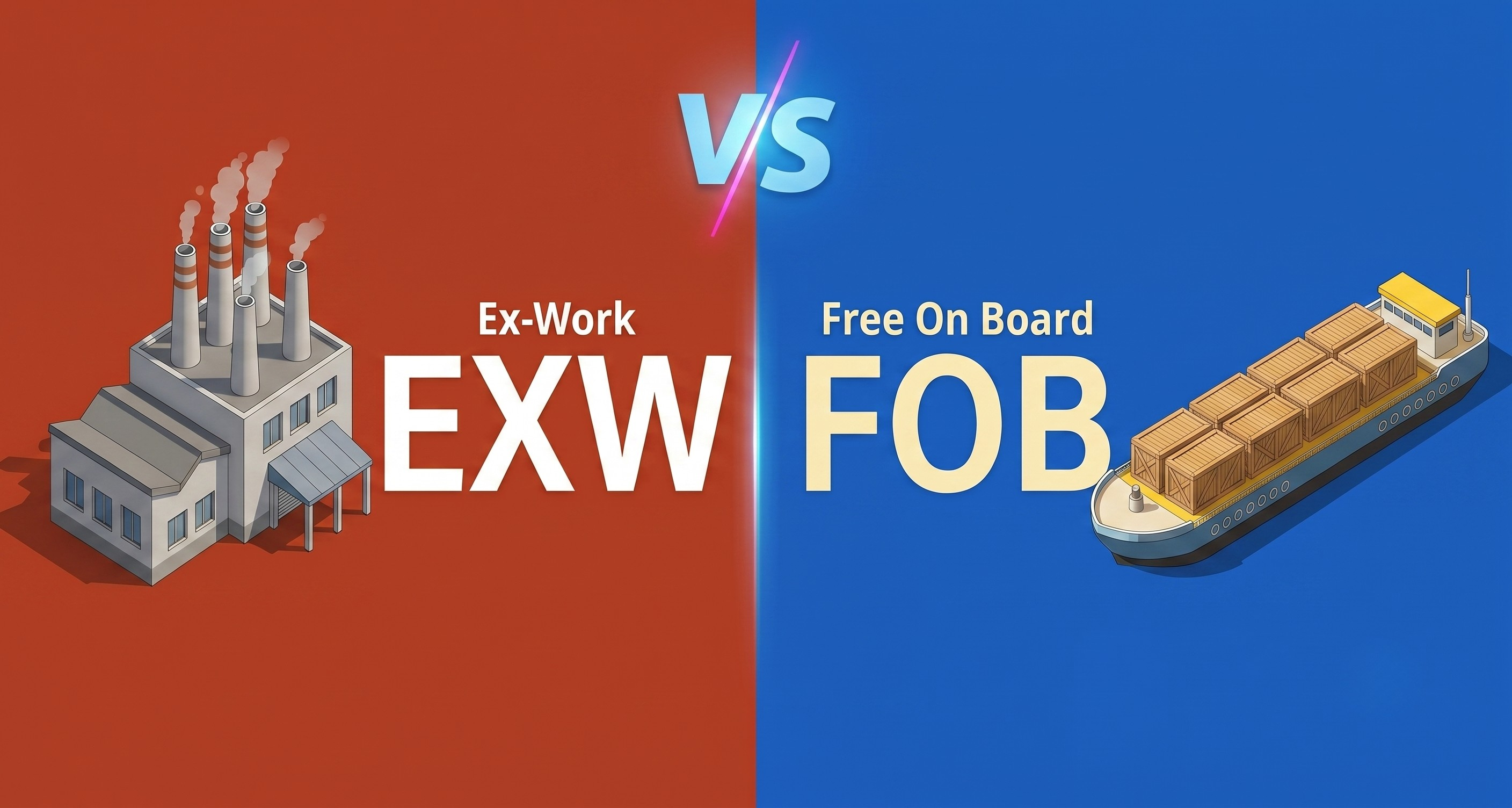
The cross-border logistics framework for consumer brands operates on a razor-thin margin of error. When importing goods from regional manufacturing hubs, a single miscalculated clause in your freight agreement can quietly transfer unexpected port fees, domestic transport liabilities, and storage costs directly onto your balance sheet. Consequently, many emerging businesses discover that their projected unit margins are entirely wiped out by the time the cargo arrives at their destination warehouse. To protect your working capital, you must understand exactly where your financial liability begins and ends. Ultimately, choosing the correct international commercial terms is the most effective way to reduce international shipping risk from your home office.
Imagine you are the founder of a growing lifestyle brand based in London or Chicago. It is June 2026, and your first mass-production run of custom consumer goods is finally complete at a factory in India. The manufacturer presents you with two pricing options on your invoice. The first option is an Ex-Works price of $10,000. The second option is a Free on Board (FOB) price of $10,500. Looking to save $500 of upfront capital, you select the cheaper Ex-Works option. You assume your local freight forwarder can easily handle the rest from their laptop.
Three weeks later, however, your shipment is blocked at the outbound port. The local transport truck was held up by regional customs authorities, and the factory refuses to handle the export documentation. Suddenly, the port authority levies emergency storage charges, handling fees, and local terminal fees amounting to $1,200. Your $500 savings has instantly mutated into a $700 net loss. This scenario is a common operational failure in international sourcing. It happens because buyers often treat freight terms as simple price discounts rather than complex legal boundaries of risk, ownership, and control.
1. Decoding the Terms: Ex-Works vs. Free on Board
To manage an overseas supply chain safely, you must look past the upfront line-item costs. You must evaluate the exact geographical point where physical liability transfers from the seller to the buyer.
The Vulnerability of Ex-Works
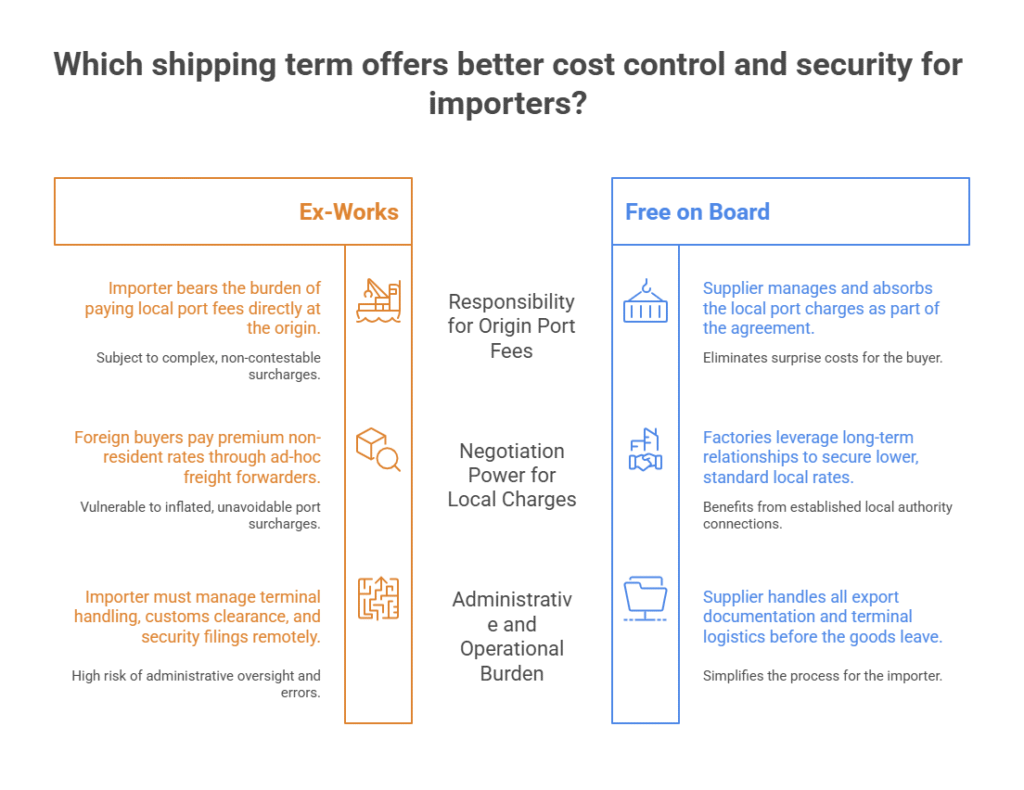
Under Ex-Works terms, the manufacturer’s legal obligation ends the moment they place the packed boxes on their own warehouse floor. Therefore, you assume total financial responsibility for the goods immediately. Your freight forwarder must manage the local pickup, transport the cargo to the export port, clear regional customs, and pay all local terminal handling fees. If a local truck driver damages your crates on the way to the port, or if customs officials block the shipment due to improper factory paperwork, the financial loss is entirely yours.
The Security of Free on Board
Conversely, Free on Board terms shift the local operational burden back onto the manufacturer. Under an FOB agreement, the supplier is legally obligated to pay for all domestic transport, clear the goods for export through their local customs authority, and pay the local port’s Terminal Handling Charges (THC). The transfer of risk only occurs when the cargo physically crosses the ship’s rail or is loaded onto the aircraft. Consequently, if an issue arises between the factory gates and the vessel, the supplier must resolve it at their own expense.
2. The Hidden Port Fees that Inflate Ex-Works Invoices
Many new importers select Ex-Works because they assume local port fees are negligible. However, outbound terminals across major Asian hubs operate under complex local fee structures that foreign buyers cannot easily contest from afar. When you ship via Ex-Works, you are responsible for paying these local fees directly at the origin port.
The Breakdown of Origin Charges
First, you face Terminal Handling Charges (THC). This is the physical cost of moving your pallet from the port staging area into the shipping container. Second, you must cover Export Customs Clearance. This is the administrative cost of filing the formal shipping bill with the local government. Finally, there are Documentation and Origin Fees. These include local port authority processing fees, gate-in fees, and mandatory security manifest filings.
The Supplier’s Local Advantage
Factories can negotiate these local fees at a much lower rate because they maintain deep, long-term relationships with local port authorities. When a foreign freight forwarder attempts to pay these fees on an ad-hoc Ex-Works basis, the local agents frequently apply premium non-resident rates. Therefore, the $500 you thought you saved on the factory floor is quietly absorbed by origin port surcharges.
Strategies to Reduce International Shipping Risk
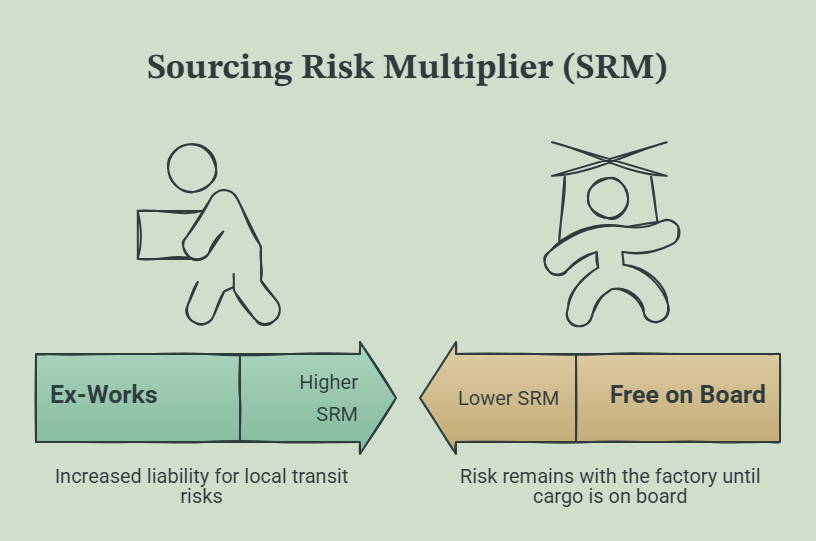
Understanding the exact point of risk transfer is critical for executing valid marine insurance claims. If your cargo is damaged mid-transit, your insurance provider will meticulously audit your chosen shipping terms to determine if you actually held an insurable interest at the exact time the damage occurred. To quantify your true financial exposure during an ocean freight voyage, logistics managers evaluate the Total Sourcing Risk Multiplier (SRM):
SRM =[{Freight Cost +Local Port Fees + Insurance Premium}/{Ex-Works Product Value}] * 100
Where the product value represents your core manufacturing cost. When you operate under Ex-Works terms, your SRM increases significantly. This inflation occurs because you pull the local transit risks of a foreign country directly into your corporate liability column. If a warehouse fire occurs at the origin port before the ship departs, an Ex-Works buyer must fight a complex, cross-border insurance battle. However, under an FOB agreement, that specific risk remains the factory’s problem until the cargo is safely on the vessel.
4. Sourcing Frameworks: Financial and Operational Comparison
Choosing between these two logistics frameworks requires a clear side-by-side analysis of where your administrative and financial obligations fall during the journey. This structural breakdown helps small brands map their exact liability windows and effectively reduce international shipping risk.
| Sourcing Logistics Milestone | Ex-Works Protocol | Free on Board (FOB) Protocol |
| Local Factory Pickup | Buyer pays and coordinates | Factory pays and coordinates |
| Export Customs Filing | Buyer’s agent must file | Factory handles completely |
| Origin Port Terminal Fees | Buyer pays local charges | Factory absorbs all origin fees |
| Damage Before Loading | Buyer absorbs the financial loss | Factory absorbs the financial loss |
| Best Suited For | Large conglomerates with local offices | Emerging brands sourcing remotely |
5. Utilizing Local Forwarders to Secure Control
While choosing FOB terms transfers local risk to the supplier, you must still maintain active visibility over the process. To ensure your factory meets their export obligations without delaying your cargo, you should deploy a tech-enabled local freight forwarder. Think of this partner as your logistics proxy. They coordinate directly with your factory’s local team to ensure documents are filed on time, preventing costly storage roll-overs.
[FOB Agreement Signed] ➔ [Factory Clears Local Customs] ➔ [Local Forwarder Audits Port Load-In]
Friction Point Management
Your local logistics proxy manages three critical friction points. First, they handle Document Audit Verification. This means checking that the factory’s export licenses match the product descriptions before the cargo hits the customs checkpoint. Importers can cross-verify these compliance steps directly through the official DGFT Portal guidelines for trade validation.
Conclusion: Strategic Clarity Over Short-Term Savings

Building a highly profitable international supply chain from your home office requires looking past upfront product discounts. True operational efficiency is built on eliminating administrative friction and unmanaged liabilities across borders. By avoiding the common trap of Ex-Works terms and demanding clear, transparent FOB pricing from your Asian manufacturing partners, you establish an automated line of defense.
In the modern global marketplace, your ultimate competitive advantage is not finding the cheapest possible unit cost. Instead, it relies entirely on the consistency of your logistics terms, the predictability of your landing costs, and the strategic reduction of your international shipping risk.