
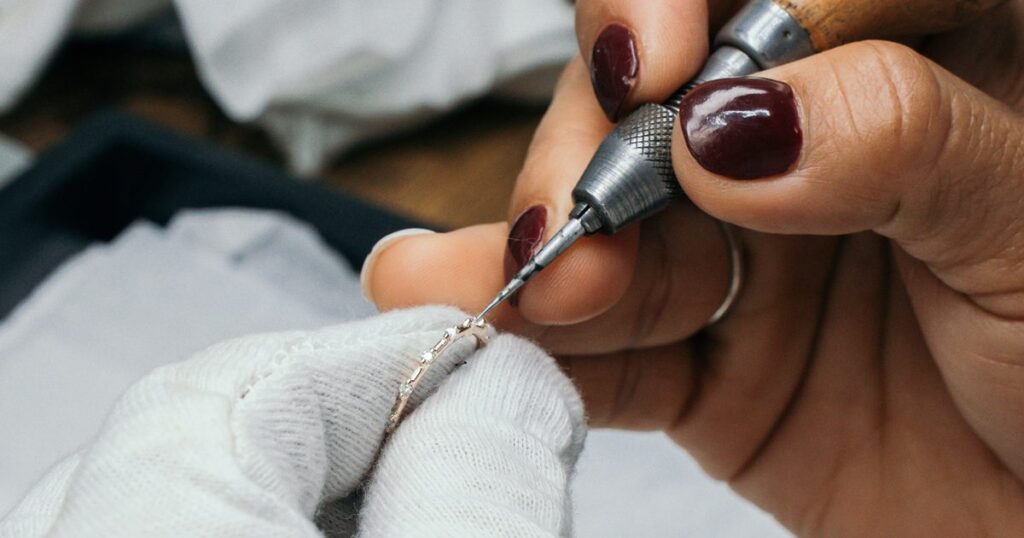
As we navigate the complexities of sourcing from India 2026, the boardroom of every mid-sized American and European importer has felt more like a war room. The Imagine you are a senior category manager for a jewelry brand in London or New York. It is April 2026, and you need to diversify your supply chain quickly. In the past, this meant flying to India, visiting dozens of factories, and “guessing” which one was the best. It was slow, expensive, and a massive drain on your capital. Historically, the jewelry industry has been one of the last to digitize, relying on handshakes and heritage rather than data and dashboards.
Today, smart brands are executing a “China Plus One” strategy, moving more production to India to avoid global trade risks. But they aren’t doing it blindly. They are using AI in jewellery sourcing to identify the right partners in record time, while still relying on local experts to handle the final, high-stakes steps of procurement. This hybrid model is the only way to navigate a market as complex and fragmented as India’s.
Part I: Why the Shift to India is Structural, Not Temporary
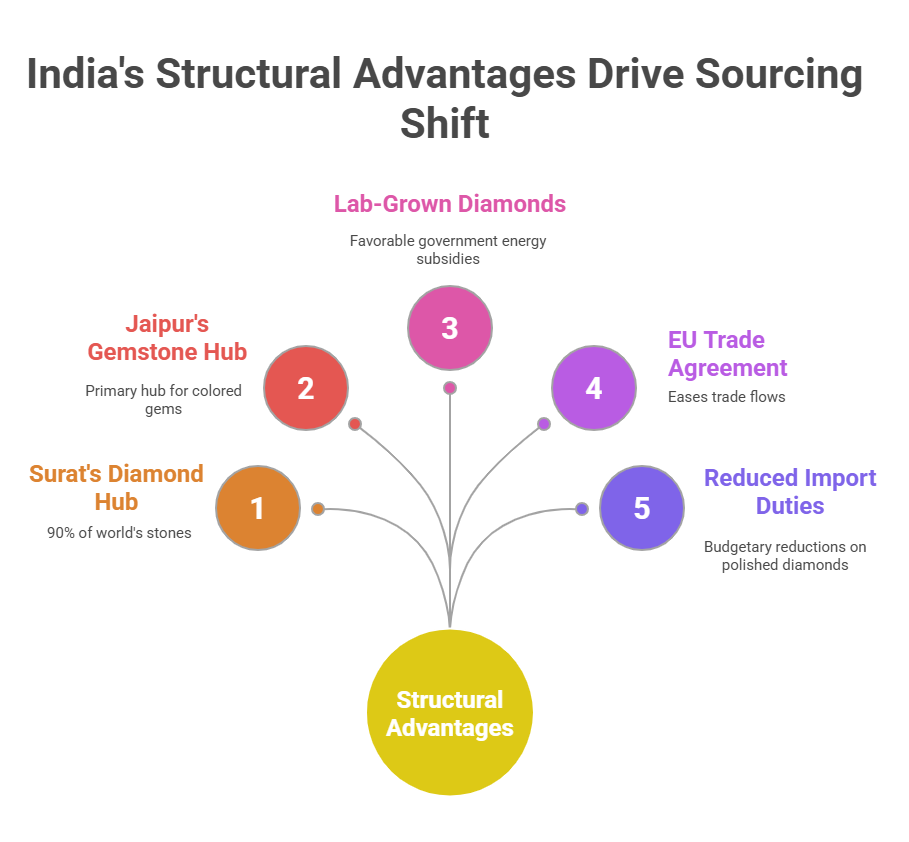
India is no longer just a backup plan—it is a structurally advantaged sourcing hub. The country offers a depth of skill and scale that is difficult to replicate. Surat remains the undisputed global capital for diamond cutting, while Jaipur is the world’s primary hub for colored gemstones. As global trade flows shift, the role of AI in jewellery sourcing has become central to identifying which manufacturers in these hubs are ready for international partnerships.
Recent policy moves are making this shift even more attractive. While the EU-India Trade Agreement reached a political conclusion in January 2026, it is expected to significantly ease trade flows once ratified, potentially removing the “latency penalty” that has plagued European importers. Combined with the Union Budget 2026-27 (reductions in import duties) on polished diamonds (now 2.5%) and continued support for small business formalization, India has positioned itself as the primary destination for brands seeking skilled labor and long-term regulatory alignment.
Part II: How AI in Jewellery Sourcing Works in 2026
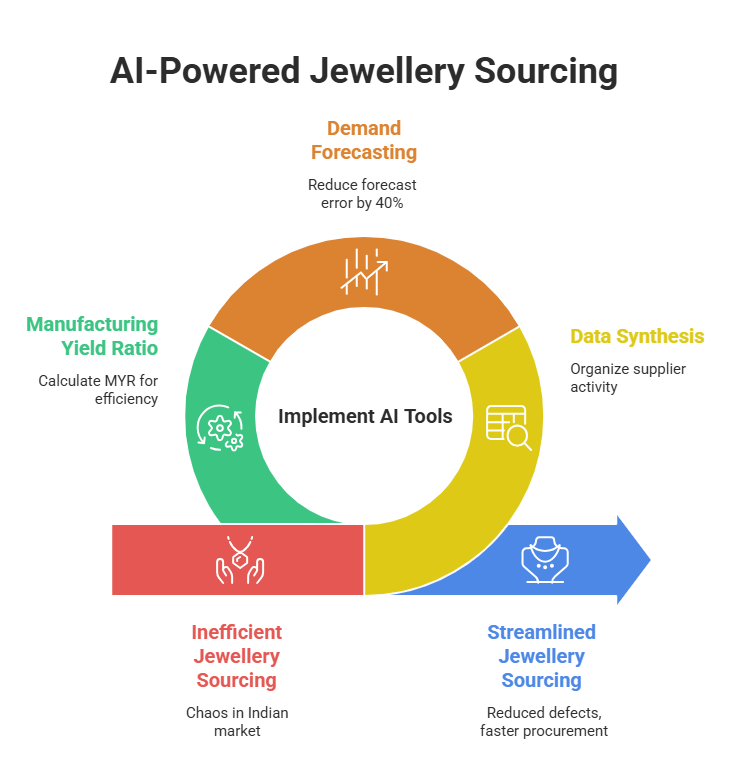
The narrative that AI can run a supply chain by itself is compelling, but often overstated. In 2026, top-tier brands use AI as a tool for data synthesis, not as a total replacement for due diligence. AI in jewellery sourcing helps organize the “chaos” of the Indian market by looking at export records, GST-linked filings, and hallmark registries to create a directional map of supplier activity.
By utilizing Temporal Fusion Transformers, sourcing managers now forecast demand with a precision that reduces forecast error by roughly 40%. This is critical for preventing the “Bullwhip Effect”—where small changes in retail demand lead to massive, wasteful over-ordering at the factory level.
Specifically, AI is now used to calculate a Manufacturing Yield Ratio (MYR):
MYR = (Wf / Wr) × Cg
where:
Wf: Final Weight / Volume
Wr: Raw or Received Weight / Volume
Cg: Conversion Grade or Constant
However, the machine has clear operational constraints:
- Uneven Digitization: Many small workshops in India still lack the digital infrastructure for real-time APIs. AI cannot “see” what hasn’t been recorded.
- Probabilistic Models: AI provides “directional improvements” on trends and delivery times, but these are probabilistic guesses, not absolute guarantees
- The Data Gap: Large factories in integrated manufacturing clusters might have great data, but artisan shops likely have none.
The Sourcing Evolution: 2024 vs. 2026
For early adopters and select product categories, the shift looks like this:
| Metric | Manual Sourcing (2024) | AI-Enabled Sourcing (Select Categories) |
| Defect Escape Rate (DER) | 5% – 8% | Under 2% (Early Adopters) |
| Procurement Cycle Time | 120 Days | 60–75 Days (Top-Quartile) |
| Inventory Turnover | 1.5x per year | 3.8x per year (Early Adopters) |
| Import Duties | Legacy Rates | Reduced (Recent Budgets) |
Part III: The Transparency Trap
Over-reliance on AI can create a false sense of control. If you rely only on a computer to pick your suppliers, you are vulnerable to the “tactile gap”—the simple fact that digital sensors cannot yet bridge the physical world. In the jewelry trade, where a fraction of a millimeter or a slight change in gold hue can ruin a collection, this gap is dangerous.
- The Feel of the Product: AI cannot verify the “hand-feel” of a finished piece or detect the subtle structural weaknesses in a hollow gold casting.
- Digital Grooming: Some suppliers may learn to optimize their data profiles—showing perfect shipping records or high hallmarking volumes—to satisfy AI filters without actually improving their factory conditions.
The Reality of Risk: AI can flag an operational anomaly, such as a drop in electricity usage, but it cannot see the human morale or management integrity of a workshop. At the end of the day, the legal and operational liability still rests entirely with the buyer.
Part IV: The “Human API” – Why AI in Jewellery Sourcing Needs a Bridge
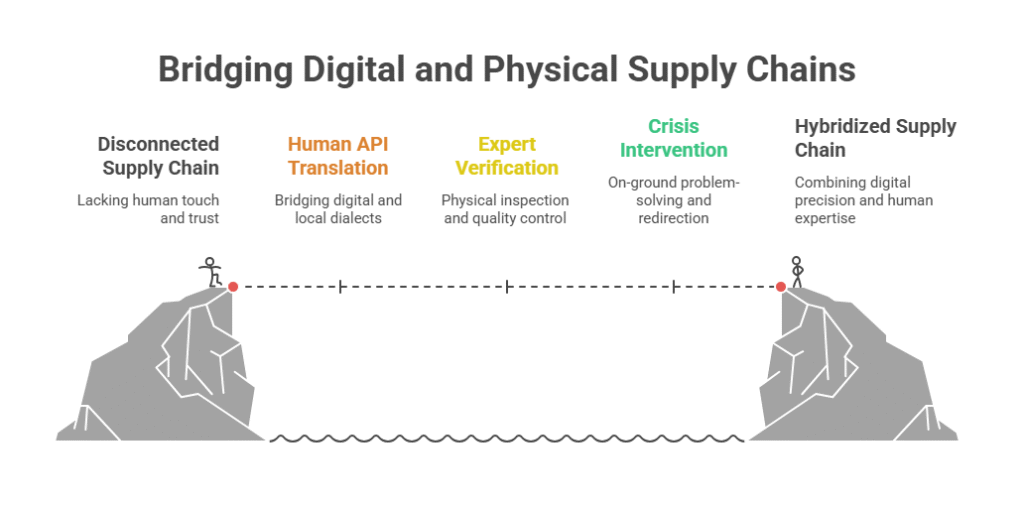
The most resilient supply chains in 2026 are not autonomous; they are hybridized. The rise of AI has redefined the traditional sourcing agent as a “Human API.” This person acts as a bridge between digital precision and on-ground reality.
They take your digital “Technical Tech Pack”—filled with 3D renders and CAD files—and translate it into the local dialect of a master craftsman. This artisan may have spent 40 years setting stones for royal families but may not own a smartphone. The Human API ensures that the “soul” of the design isn’t lost in the digital translation.
The Human Expert handles the “Last Mile” that AI cannot:
- Crisis Intervention: Stepping in when digital systems flag a disruption. If a local festival or a monsoon-related power failure stops production, a person on the ground can move the order to a backup unit in hours, whereas an algorithm might simply issue a “delayed” alert.
- Final Physical Verification: Providing the physical, last-mile loupe inspection. They check for “glass-filling” in rubies or “surface reaching inclusions” that a camera might miss under studio lighting.
- Crisis Intervention: Stepping in when digital systems flag a disruption. If a local festival or a monsoon-related power failure stops production, a person on the ground can move the order to a backup unit in hours, whereas an algorithm might simply issue a “delayed” alert.
Part V: Strategic Implementation for US and EU Brands
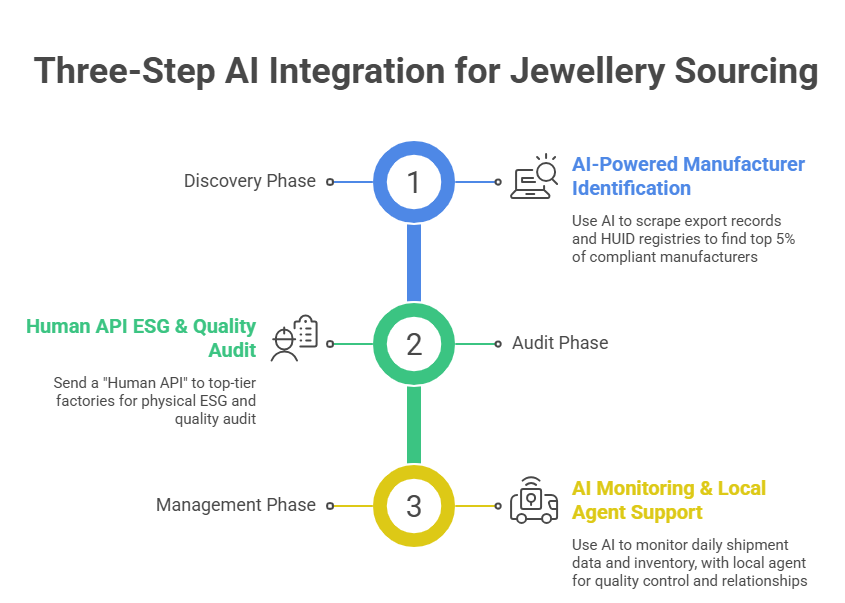
For brands looking to implement AI in jewellery sourcing, the transition must be phased. You cannot move from 100% manual to 100% digital overnight. The most successful retailers in 2026 follow a three-step integration:
- Discovery Phase: Use AI to scrape export records and HUID (Hallmark Unique ID) registries to identify the top 5% of compliant manufacturers.
- Audit Phase: Send a “Human API” to these top-tier factories to perform a physical ESG (Environmental, Social, and Governance) and quality audit.
- Management Phase: Use AI to monitor daily shipment data and inventory levels, while keeping your local agent on retainer for quality control and relationship management.
The Indibuying Verdict: Data-Driven, Human-Led

The future of AI in jewellery sourcing is characterized by hybrid intelligence. AI handles the heavy lifting of data synthesis, discovery, and forecasting. However, humans remain the essential layer for trust, quality verification, and strategic relationship management.
For brands in the US and Europe, the objective is to use AI to find the needle in the haystack, and then rely on seasoned professionals to ensure that needle remains sharp. By anchoring technology in the reality of Indian craftsmanship, retailers can build supply chains that are as resilient as they are efficient. In a world of increasing digital data, the ultimate competitive advantage is knowing when to trust the algorithm—and when to trust the loupe.