

Imagine you are the Head of Sourcing for a mid-market jewellery retailer in London. For years, your supply chain has relied on a sourcing office, a small team that charges a 7% commission to navigate the chaotic lanes of Johari Bazar. To your CFO, this 7% looks like a trust tax that needs to be optimized. Jewellery sourcing from India is a high-stakes endeavor, and the temptation to automate is growing.
Then comes the 2026 sales pitch from a Silicon Valley-backed agentic AI platform. The software promises to automate supplier discovery, handle GST audits, and verify lab-grown diamond (LGD) certifications for a flat monthly fee of $2,000. On a $1 million annual spend, the math is seductive: you save $50,000 in commissions overnight.
You pull the trigger. But six months later, you realize that while the AI successfully audited the factory’s financial records, it couldn’t smell the impending strike at the polishing unit or notice that the natural rubies in your latest batch had a suspicious glass-fill that only a 10x loupe and a seasoned eye could catch.
Why This Matters
As jewellery sourcing from India becomes a critical pillar for retailers diversifying away from China, the industry is hitting a transparency wall. India’s gem and jewellery exports are projected to reach $31.14 billion in 2026, yet the sector remains stubbornly fragmented. You can track the broader shift in our analysis of India vs China sourcing in 2026.
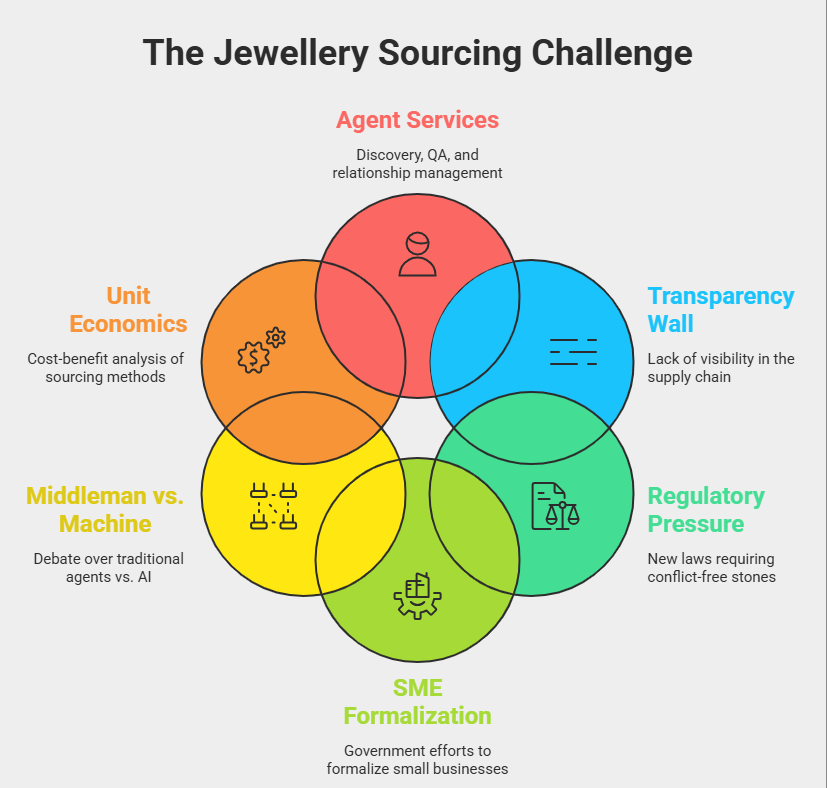
The stakes are high: with the US and EU tightening traceability laws on conflict-free stones, the Middleman vs. Machine debate isn’t just about cost—it’s about who carries the liability. For real-time updates on these regulations, sourcing managers should monitor the GJEPC India official portal.
Part I: The Unit Economics of the “Trust Tax”
To understand why AI hasn’t yet killed the traditional agent, we have to look at the unit economics of a typical sourcing transaction. In the jewellery trade, the agent provides three distinct services: Discovery, Quality Assurance (QA), and Relationship Management.
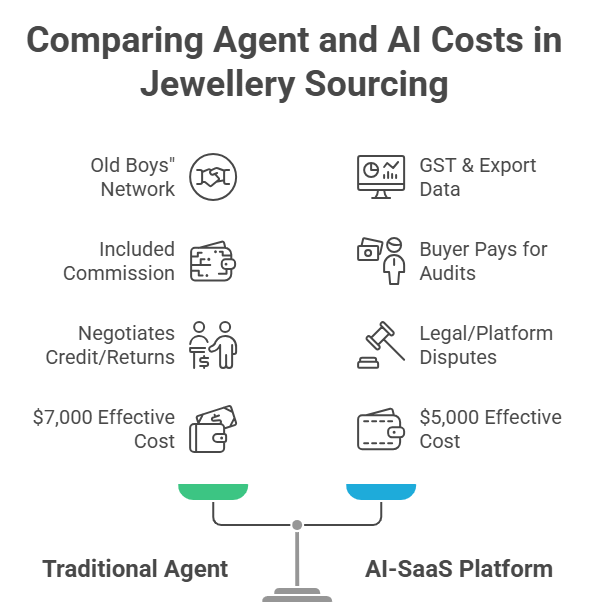
Table 1: Cost vs. Value Analysis (1,000 Unit Order)
| Service Layer | Traditional Agent (7% Commission) | AI-SaaS Platform ($2k/mo) | The “Grey Area” |
| Discovery | Relies on “Old Boys” network. | Scrapes GST & Export data. | AI finds new vendors; Agents find vetted ones. |
| Audit Cost | Included in commission. | Buyer pays for 3rd party audits. | AI can’t verify “Subsurface Porosity” in casting. |
| Conflict Resolution | Agent negotiates credit/returns. | Buyer files legal/platform disputes. | Agents “eat” small losses to keep the client. |
| Effective Cost | $7,000 (on $100k order) | $2,000 + $3,000 (Audit/Travel) | The “gap” is smaller than it looks on paper. |
For a global retailer, the AI-first model appears cheaper until you calculate the Defect Escape Rate. Current AI visual inspection systems (like those used in 2026) have a 92-98% accuracy rate for casting defects. That sounds high, but in high-fine jewellery, a 2% failure rate on a $100,000 shipment is $2,000—exactly the savings the SaaS model promised.
Part II: The Final Mile Chokepoint in Jaipur and Surat
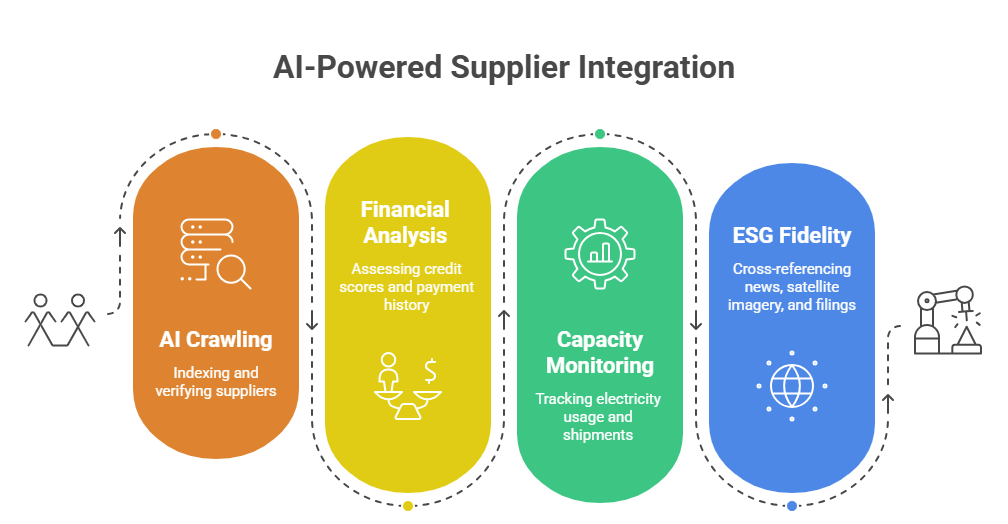
India’s strength lies in its cluster manufacturing. Jaipur handles coloured gemstones; Surat dominates diamonds; Mumbai handles high-end gold. An AI can track a HTS (Harmonized Tariff Schedule) code, but it cannot navigate the Informal Chokepoint. To understand how these city-specific costs add up, see our Jewellery Landed Cost Guide.
Many of India’s most skilled artisans operate in units that lack digital ERPs. The traditional agent acts as a human API. They translate the retailer’s “Technical Tech Pack” into the local dialect of a master craftsman who has been setting stones for 40 years but doesn’t use a laptop. Without this human bridge, jewellery sourcing from India often results in “lost in translation” product defects that cost more than the commission saved.
Part III: The Problem with “Data-Driven” Quality
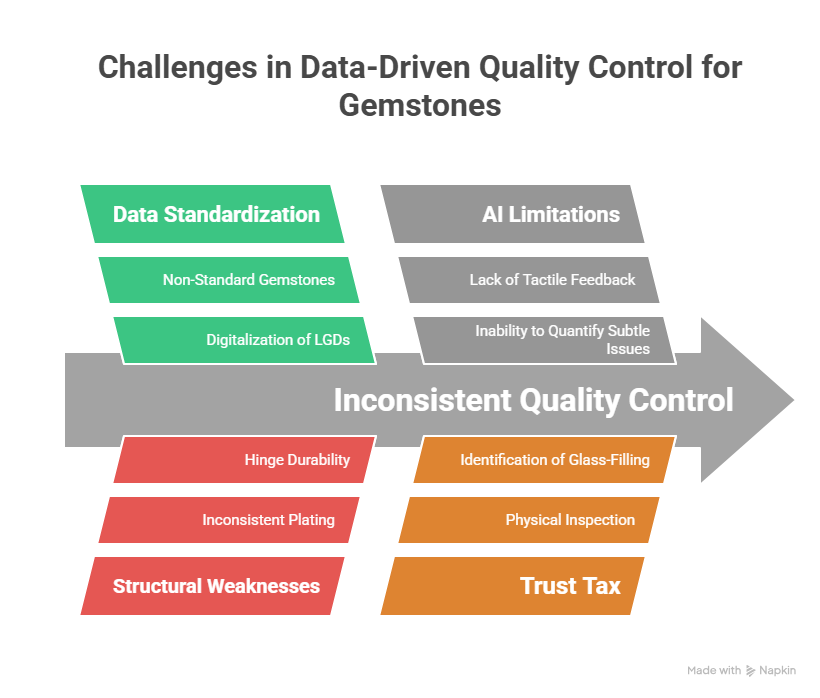
AI models thrive on standardized data. However, gemstones are inherently non-standard. While Lab-Grown Diamonds (LGDs) are increasingly digitized, natural stones are un-standardizable.
The 2026 shift toward daily wear jewellery—stackable rings and modular necklaces—requires consistent plating thickness and hinge durability. When an AI inspects a shipment via high-resolution camera, it often misses the “feel” of a clasp or the subtle tinny sound of a hollow gold earring. These are markers of structural weakness that a machine cannot yet quantify. Furthermore, the “trust tax” paid to an agent covers the physical 10x loupe inspection that identifies glass-filling in rubies—a process that requires tactical manipulation of the stone under specific light.
The Regulatory Squeeze: 2026 and Beyond
The 2026 regulatory landscape is making “invisible” sourcing a liability. The Indian government’s push for Hallmarking 2.0 and the proposed reduction in import duties on rough stones are designed to bring the unorganized sector into the light.
- Traceability: Global retailers now demand Cradle-to-Gate data. AI is the clear winner here. It can store blockchain certificates and digital twins of every stone more efficiently than any human agent.
- The Safe Harbour Tax: Many Indian exporters face high safe harbour taxes (around 4%). A sophisticated sourcing office uses AI to optimize these tax filings, turning a technical cost center into a competitive edge.
- ESG Compliance: In 2026, “Green-washing” is a legal risk. While AI can scan satellite imagery for factory compliance, only a “foot on the street” can verify that the “Green Factory” isn’t outsourcing the heavy polishing to a non-compliant basement unit down the street. This verification is essential for ethical jewellery sourcing from India.
The Indibuying Verdict: The Rise of the “Architect”

The conclusion to the Middleman vs. Machine debate is not the death of the agent, but the evolution of their role. We are moving toward a hybridized model—what we at Indibuying call the Sourcing Architect.
The future belongs to the sourcing agent who uses AI to handle the $2,000 worth of “data grunt work” (GST tracking, HTS classification, and HSN audits) while charging their commission for the high-value “Human Intelligence” that machines cannot replicate. For a London retailer, the goal is not to eliminate the 7% fee, but to ensure that 7% buys them a bulletproof supply chain.
Ultimately, in a world of perfect digital data, the only true competitive advantage is the one you can’t download: the ability to loupe a stone, look a supplier in the eye, and know exactly which one is telling the truth.