

Imagine you are the Head of Sourcing for a multi-billion dollar European retailer. A sudden geopolitical shift has just bottlenecked your primary textile route through Southeast Asia. Historically, this would trigger weeks of frantic emails, manual vetting of outdated supplier directories, and the high-stakes gamble of onboarding unverified partners in a rush. By 2026, AI sourcing suppliers has completely changed this scenario. Within seconds, your autonomous interface scans the subcontinent to find real-time factory capacity.
By 2026, this scenario has changed. Within seconds, your procurement interface, powered by autonomous agents, has already scanned the Indian subcontinent. It hasn’t just found “suppliers”; it has cross-referenced real-time factory floor capacity in Coimbatore with ESG compliance ratings and verified export licenses in Tiruppur.
This is the shift from manual search to AI sourcing suppliers, a transition that is turning one of the world’s most fragmented manufacturing landscapes into a transparent, high-velocity digital ecosystem.
Part I: The Death of the Static Directory
Historically, discovering suppliers in India was an exercise in “who you knew.” Global retailers relied on a patchwork of trade shows and static databases. Consequently, these sources often became obsolete the moment they were published. The inherent friction of manual discovery meant that only a fraction of India’s manufacturing units remained visible.
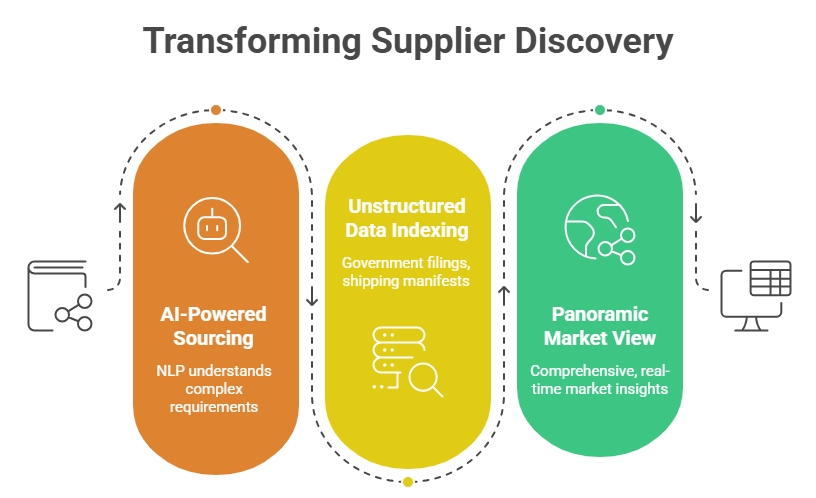
Today, AI is dissolving these barriers. Specifically, modern sourcing tools use Natural Language Processing (NLP) to understand complex requirements. Unlike traditional search engines, these agents index unstructured data from government filings and shipping manifests. As a result, the discovery phase now takes hours instead of months.
By indexing unstructured data from government filings, shipping manifests, and social sentiment, AI provides a panoramic view of the market. The “discovery” phase, which once took months of air travel and local networking, is now compressed into hours of high-precision matching.
Part II: Why AI Sourcing Suppliers is the 2026 Standard
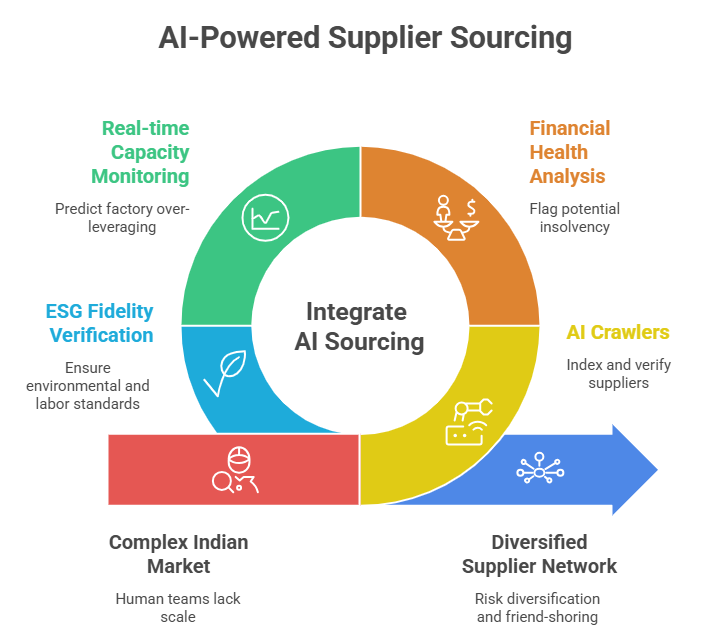
The move toward India is no longer just about labor arbitrage; it is about risk diversification and “friend-shoring.” This shift is supported by evolving trade frameworks, such as the EU-India Free Trade Agreement, which seeks to streamline market access. However, the sheer complexity of the Indian regulatory and industrial landscape requires a level of oversight that human teams cannot provide at scale alone.
The integration of AI sourcing suppliers allows retailers to move beyond the “Tier 1” factory level. AI crawlers now continuously index and verify:
- Financial Health: Analyzing credit scores and payment histories to flag potential insolvency before a contract is signed.
- Real-time Capacity: Monitoring electricity usage patterns and shipment data to predict if a factory is over-leveraged.
- ESG Fidelity: Cross-referencing local news, satellite imagery, and government filings to ensure environmental and labor standards are met.
| Feature | Manual Discovery (Pre-2024) | AI-Enabled Sourcing (2026) |
| Search Scope | Limited to trade show participants | Millions of indexed profiles |
| Vetting Time | 4–12 Weeks | Real-time / 24 Hours |
| Data Source | Self-reported by supplier | Multi-source verification (crawlers) |
| Risk Assessment | Reactive (after a failure) | Predictive (signals-based) |
Part III: From Matchmaking to Autonomous Management
The current evolution of procurement technology has moved past simple matchmaking. We are entering the era of the autonomous sourcing workflow. In this model, the software initiates the Request for Proposal (RFP) and suggests a negotiation strategy based on landed cost data.
In the Indian context, this is particularly potent. The country’s manufacturing sector is undergoing a structural reset, moving from high-volume generics to complex, platform-led innovation in sectors like biopharma and technical textiles. For a global retailer, the challenge is no longer finding a factory but finding the right innovation partner.
AI-native platforms now offer agents that can compare thousands of line items across unit prices, shipping logistics, and payment terms in seconds. This allows procurement leads to focus on high-level strategy rather than the administrative burden of vendor onboarding.
Part IV: The Human-in-the-Loop: Why Agents Remain Vital
While the digital transformation of AI sourcing suppliers provides the “what” and the “where,” the “how” often remains a deeply human endeavor. Technology can verify a certificate, but it cannot yet navigate the cultural nuances of a high-stakes negotiation in a boardroom in Ahmedabad or Bengaluru.
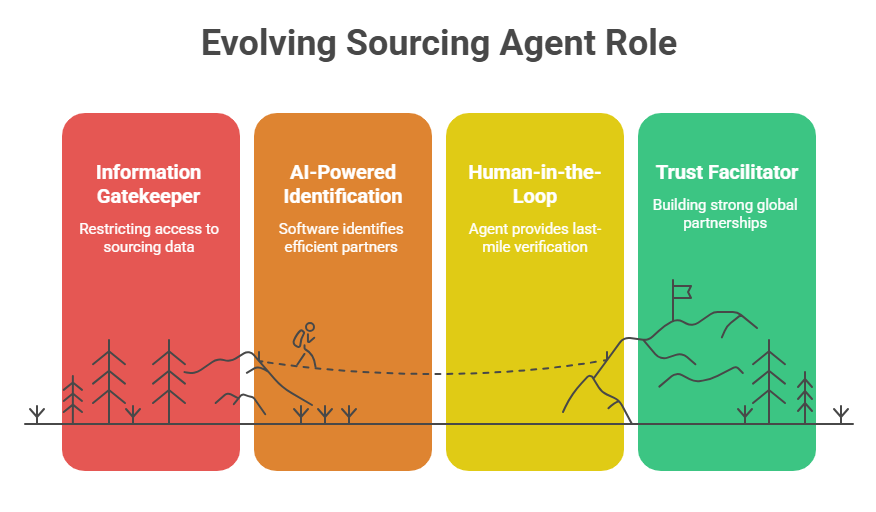
The rise of AI has not rendered the traditional sourcing agent obsolete; rather, it has redefined their value proposition. The role of the agent is shifting from a gatekeeper of information to a facilitator of trust.
While the software identifies the most efficient partner, the human agent provides the last-mile verification that machines cannot:
- Cultural Translation: Bridging the gap between global corporate expectations and local operational realities.
- Soft Vetting: Assessing the “unspoken” health of a partnership—factory morale, management integrity, and long-term commitment.
- Crisis Intervention: Stepping in when digital systems flag a disruption that requires physical presence and local problem-solving.
The Indibuying Verdict: A Hybrid Future

The future of Indian procurement is neither purely manual nor entirely robotic. Instead, it is a hybridized model where the speed of silicon meets the nuance of the boardroom. Specifically, AI handles the heavy lifting of data synthesis while human expertise provides the strategic context required to maintain healthy, long-term partnerships.
For global retailers, the objective is no longer a simple choice between technology and tradition. Rather, the goal is to use AI to find the needle in the haystack and then rely on seasoned sourcing professionals to ensure that needle remains sharp. By integrating AI sourcing suppliers into a framework that still values human intuition, retailers can build supply chains that are as resilient as they are efficient. Ultimately, those who master this digital-human synergy will secure a dominant competitive edge in the 2026 trade landscape.